Dashboard
What strands-robots dashboard serves, who may click, the two e-stops, and the agent console behind the consent card.
At the end of this page strands-robots dashboard is serving, and you know what each tab does, who may click, and what the e-stops do.
pip install 'strands-robots[dashboard,sim-mujoco]'      # fastapi, uvicorn, webauthn, PyJWT + MuJoCo for the twin
strands-robots dashboard --open                          # http://127.0.0.1:8090
Flags: --host (default 127.0.0.1), --port (default 8090), --open, --log-level. A non-loopback host is refused until a passkey or static security.auth_token guards the API.
What it serves


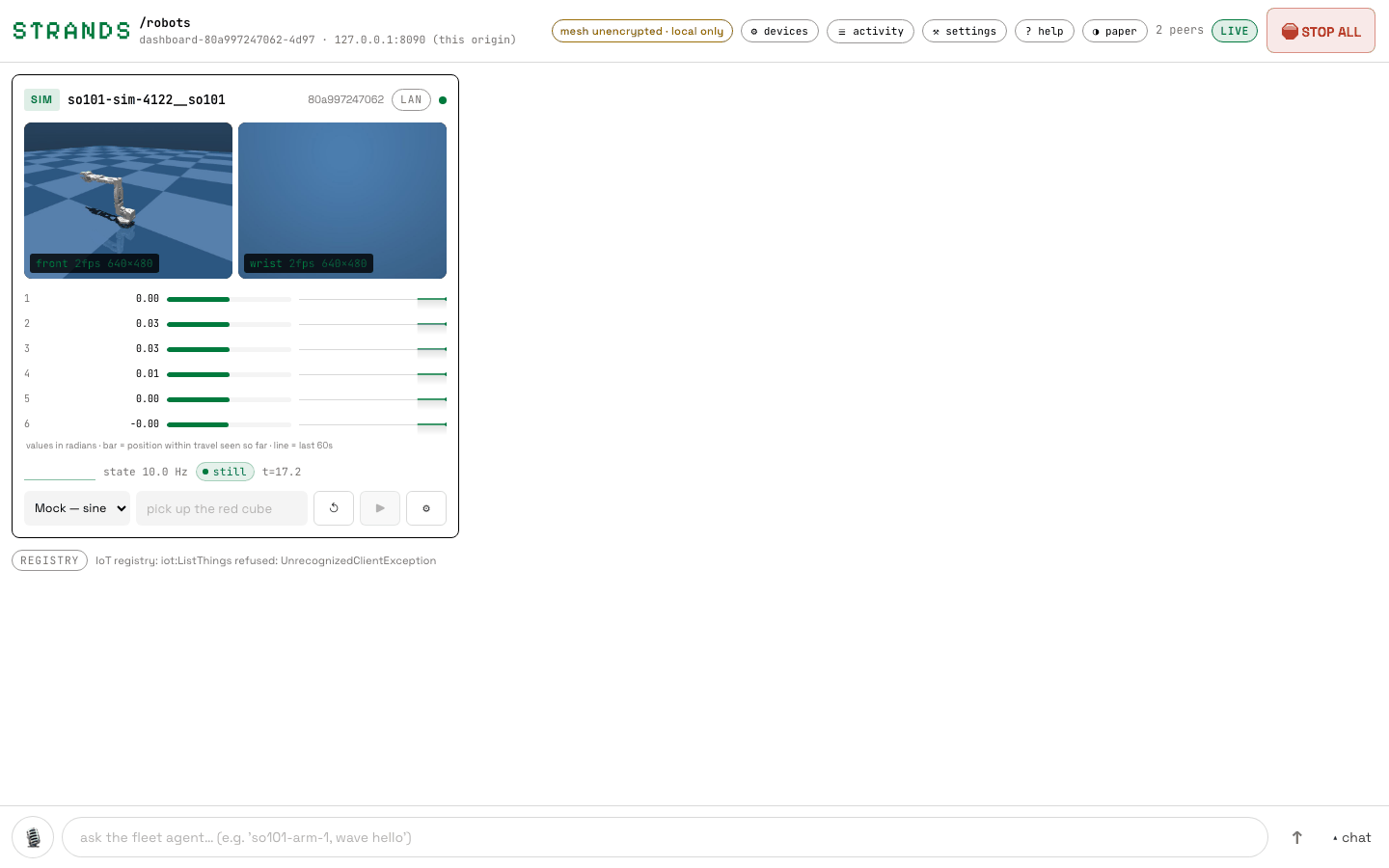
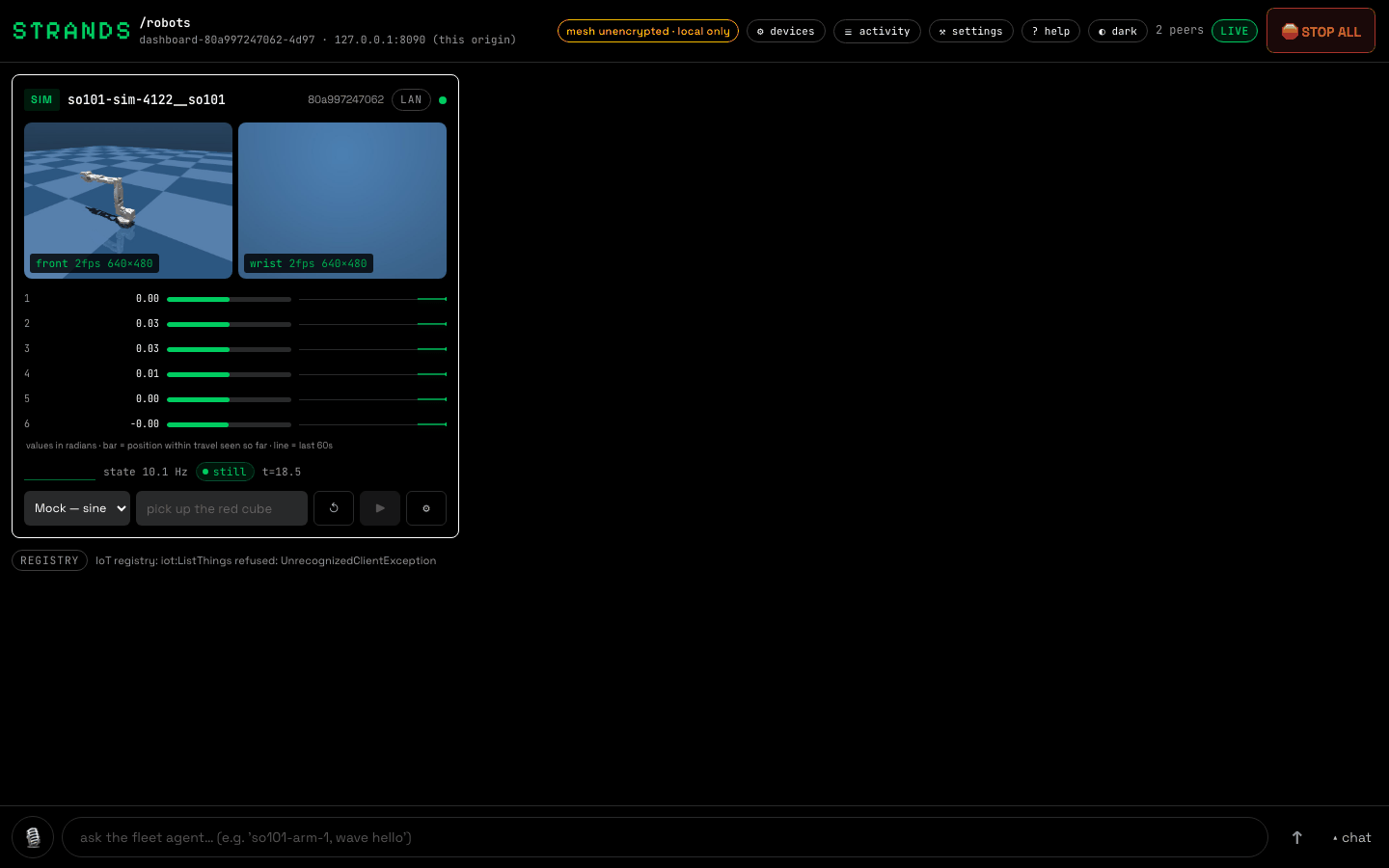
The process joins the Zenoh mesh as a robot-less gateway, under the same posture as your peers (STRANDS_MESH_LOCAL_DEV=true on one machine): one page drives hardware, simulators or both; every robot shown is a mesh peer. The UI is a built React SPA under strands_robots/dashboard/static/; no node at runtime.
| tab | shows |
|---|---|
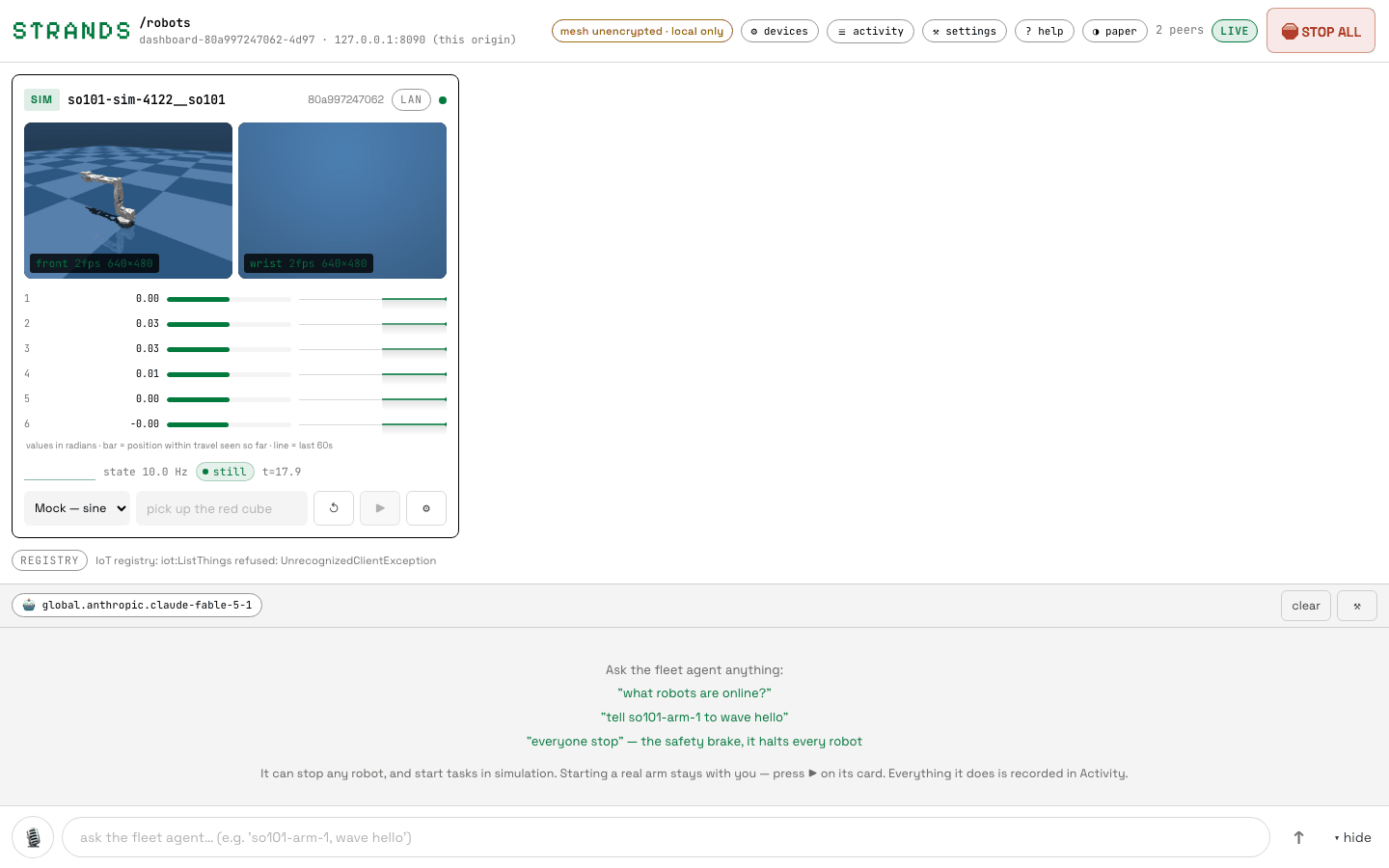
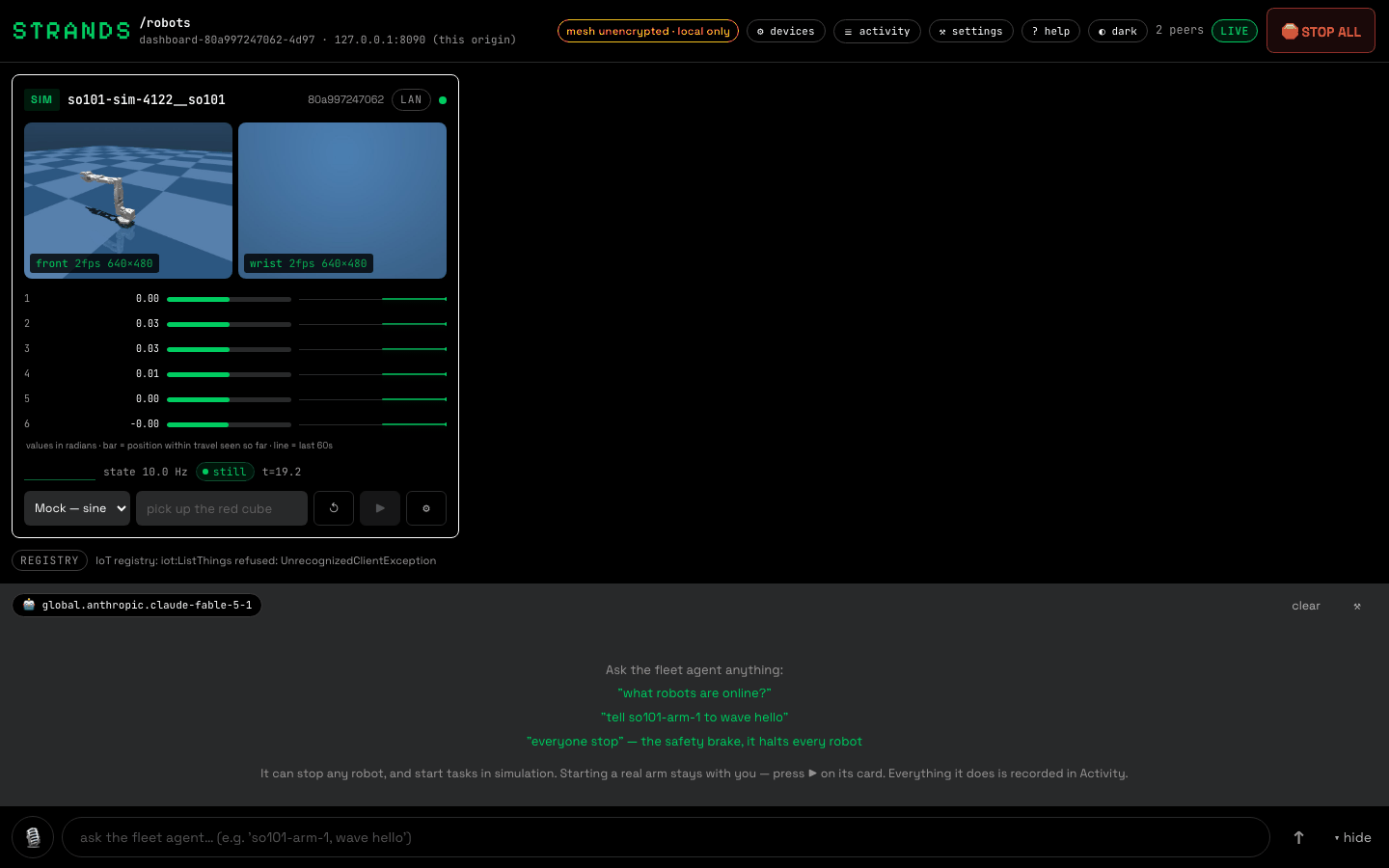
| Fleet | every live mesh robot (joints, cameras, task, lockout; a host process folds into its __ robots) and every registry robot; teleop pairing, a task form |
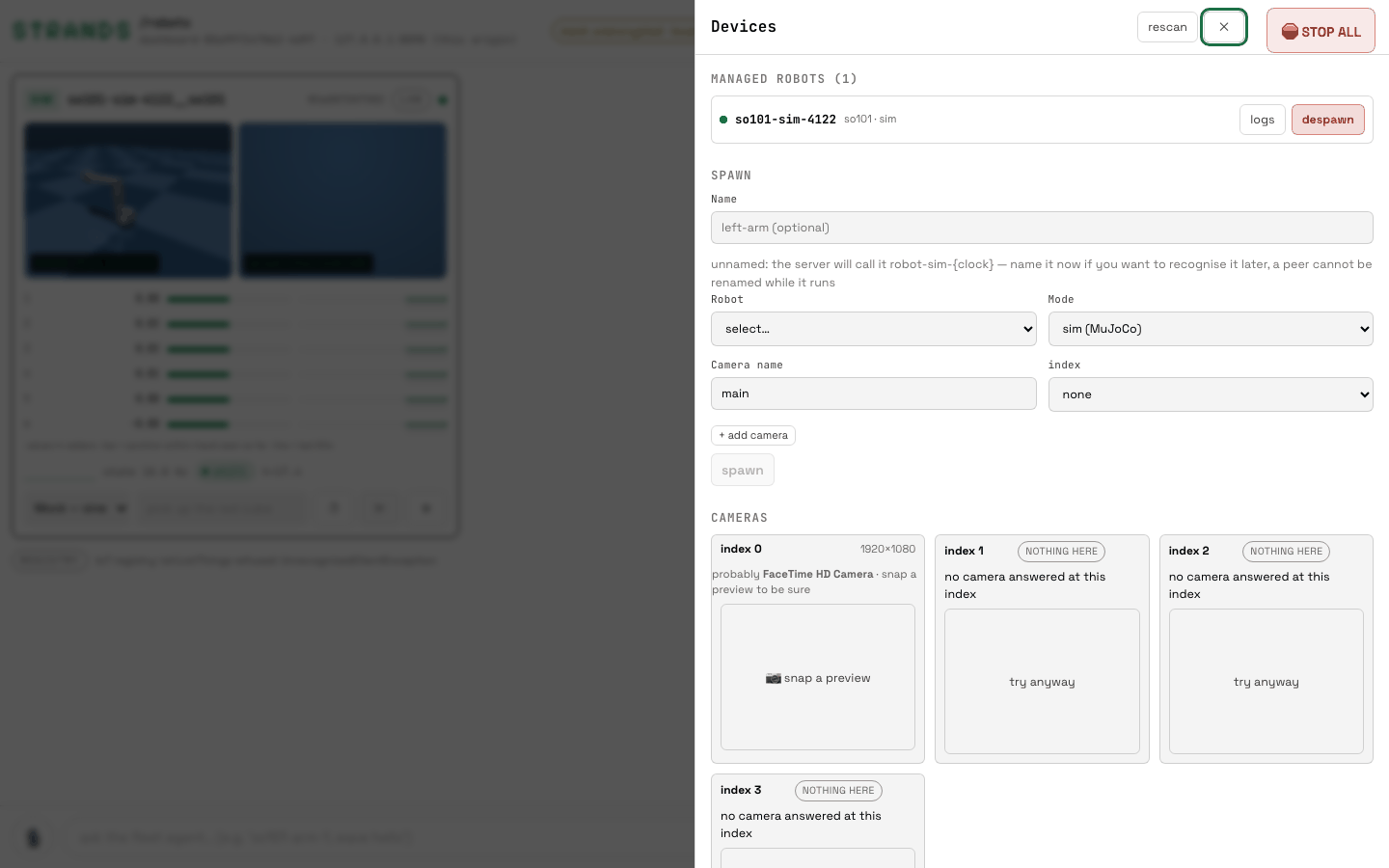
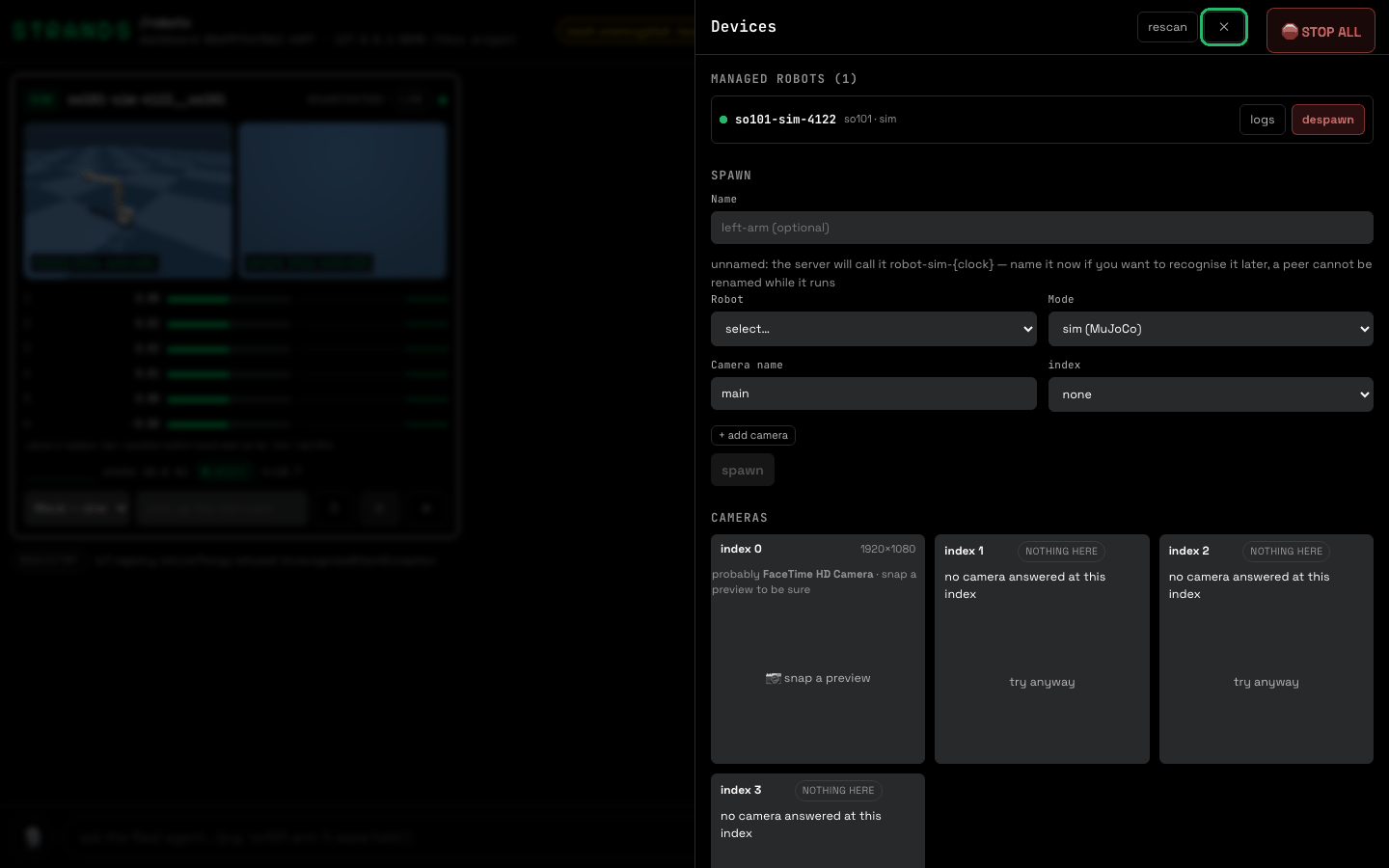
| Devices | local serial ports and cameras; spawn a robot process per port or network address (a mesh child), assign cameras, read logs, despawn |
| Calibrate | the LeRobot calibration wizard, with a confirm before the arm moves |
| Agent | a Strands Agent whose tools are the fleet's peers; anything that moves a real robot pauses on a consent card; a microphone opens voice |
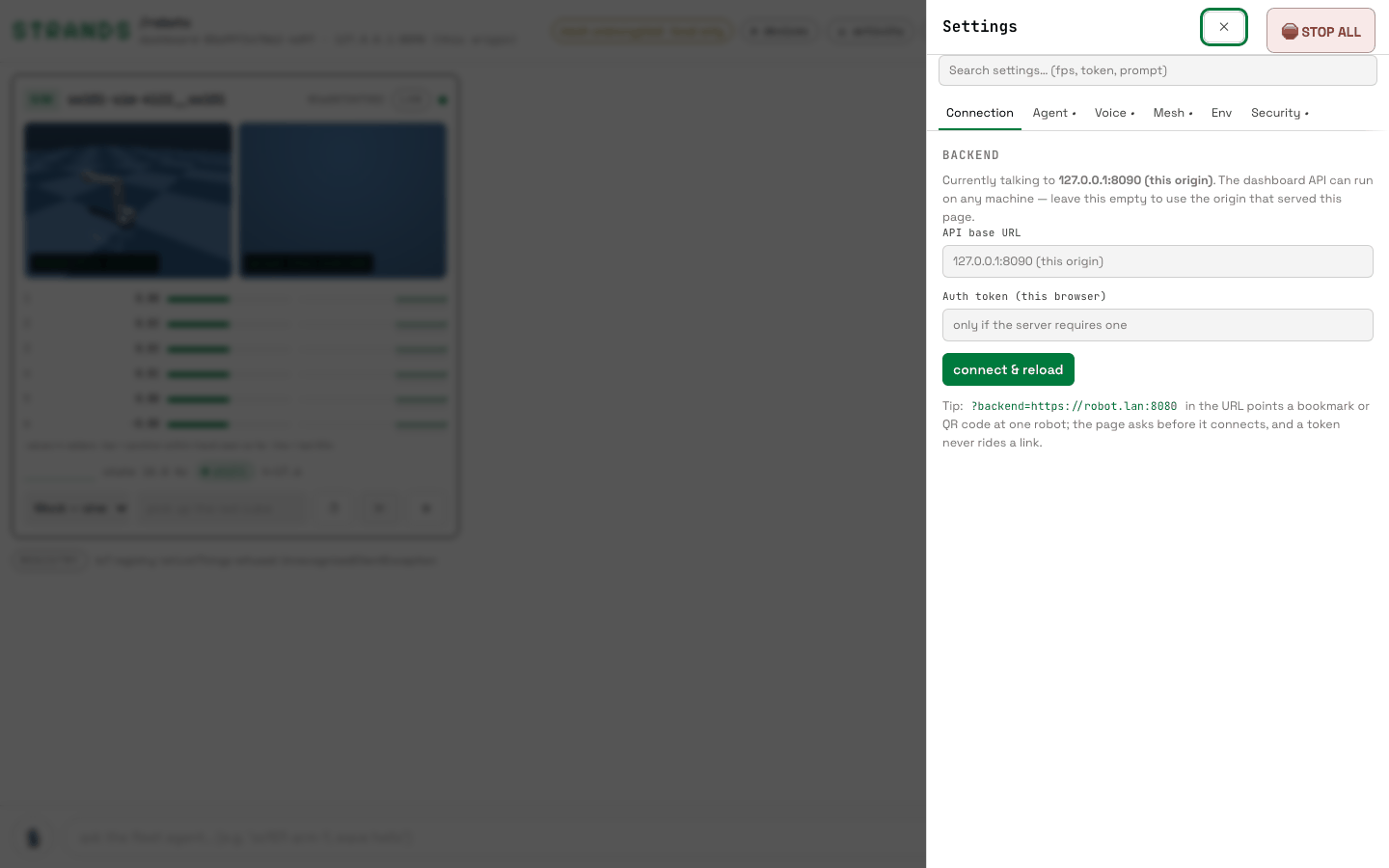
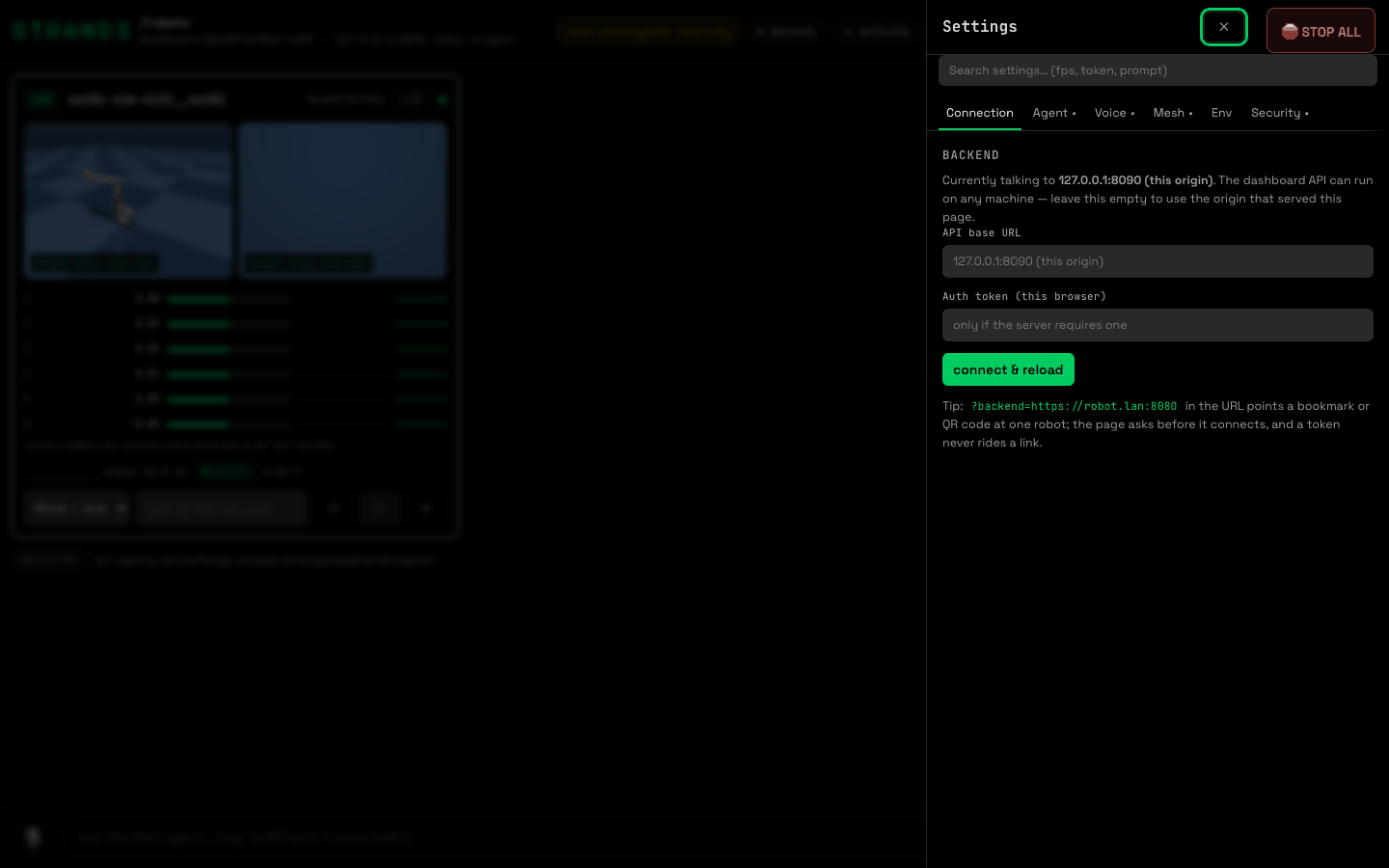
| Settings | agent model and prompt, mesh endpoints, voice provider, editable .env keys (a closed set; gates read-only), static token shown as set / unset |
Every path a client names is resolved and must sit under its home (HF_LEROBOT_HOME, STRANDS_TRAIN_OUTPUT_DIR, the Hub cache); anything else gets one refusal that never reveals whether the path exists. A port must be a /dev/... path, a robot id one segment, a camera name [A-Za-z0-9._-]: each becomes a file name or argv.
Two e-stops: POST /api/safety/estop stops this process's simulations; POST /api/mesh/safety/estop is the signed fleet stop, whose answer names the peers that did not reply. The page fires both.
Who may click
One dependency, access.require_session, guards every route but the login screen and /api/health. Three ways in, first match wins:
- A passkey session token: the
strands_dashcookie beforeAuthorization: Bearer; never a query string. - The static
security.auth_token, compared in constant time. - The bootstrap token as bearer, only while no passkey is enrolled, from this machine's own browser: loopback socket, no proxy header, a loopback
Host, anOriginnaming the same host.
The first passkey closes the third door. Both need STRANDS_DASH_AUTH_BOOTSTRAP_TOKEN, or the token the process minted into a 0600 file beside the credential store. STRANDS_DASH_AUTH_ORIGIN and STRANDS_DASH_AUTH_RP_ID pin the WebAuthn origin and relying party behind a proxy; STRANDS_DASH_AUTH_TOKEN_TTL (86400 s), ..._SESSION_MAX_AGE (2592000 s) and ..._HANDOFF_TTL (300 s) bound a session; a non-integer value is refused. A device handoff takes a fresh passkey tap and yields a one-time code. STRANDS_DASH_CONNECT_ORIGINS lists origins the page may dial.
Signing out or removing a passkey ends its sessions, open sockets included (re-checked every 2 s). Adding a passkey or removing the last needs the bootstrap proof.
The e-stop button
POST /api/safety/estop stops every sim session in this process and locks; every route that would move a sim answers 423 until it clears. POST /api/safety/resume sets the state to unknown on purpose: a resume is a request, not proof; the first command a session accepts is, and only then does GET /api/safety say clear. The signed fleet stop (safety and e-stop) is a separate rail; its verdict is fleet in that answer.
The agent in the browser
/ws/agent takes {"type": "say", "text": ...} and streams the console's events back (text, tool_use, tool_result, interrupt, done, error). The agent holds no robot of its own: fleet lists the peers, spawn_robot starts a registry robot in simulation as a new peer, and each peer is a tool named after it. Its emergency_stop shares the HTTP routes' Safety object, so the e-stop refuses the agent too. A motion verb on a real arm raises the real-hardware hook's interrupt (MotionInterruptHook, see agents); the browser shows a consent card and {"type": "resume", "id": ..., "approve": true, "always": false} resumes the turn; always lasts the conversation and dies with the socket. One turn per socket; a second say is refused.
Two switches, off by default, matter once a physical peer is reachable: STRANDS_DASH_AGENT_PHYSICAL_MOTION=1 lets the agent's tools move metal; STRANDS_DASH_TASK_REQUIRES_CONFIRM=1 makes a real-motion task or teleop POST carry a boolean confirmation (strings are refused). Neither touches a simulated peer; both are granted and revoked from a consent card, never from Settings.
Logs
Every log line passes log_redaction: tokens, cookies and credential ids are masked.