Recording & datasets
from strands_robots import Robot

sim = Robot("so100")
sim.start_recording(repo_id="user/my_dataset", task="pick up the cube", fps=50)
sim.run_policy(robot_name="so100", instruction="pick up the cube",
               policy_provider="mock", duration=10.0)
sim.stop_recording()
# LeRobot v3 dataset written to $HF_LEROBOT_HOME/user/my_dataset
start_recording requires [lerobot]. Without it, use start_cameras_recording for plain MP4.
fps must equal the rollout's control_frequency
The recorder captures one frame per control step and never decimates, so the
rate frames arrive at is the rollout's control_frequency - and LeRobot derives
every timestamp from the dataset's declared fps positionally
(timestamp = frame_index / fps). A differing fps therefore cannot be
honored, only mislabelled, so it is refused:
sim.start_recording(repo_id="user/my_dataset", task="t", fps=30)
sim.run_policy(robot_name="so100", policy_provider="mock")   # default 50.0 Hz
# -> "run_policy: the active recording declares 30 fps but this rollout captures
#     at control_frequency=50 Hz. [...] a 1.667x distortion of the episode
#     duration [...] Align the two rates: pass control_frequency=30 to
#     run_policy(), or record at the rollout's rate"
The refusal lands before any frame is written, so nothing is lost - pass either
rate. It matters beyond the label: that per-frame interval is the control period
a policy trains on, and replay_episode derives its per-frame physics budget
from the dataset rate, so a mislabelled episode also replays at the wrong speed.
To record at a lower rate than you control at, run the rollout at that rate -
there is no decimating recorder.
PolicyRunner is drivable directly, and the engine's check is not on that path,
so PolicyRunner.run / PolicyRunner.evaluate apply the same rule themselves.
They raise ValueError rather than returning an error dict, because a direct
caller has no tool envelope to read:
runner = PolicyRunner(sim)
runner.run("so100", policy, control_frequency=50.0, on_frame=hook)
# -> ValueError: PolicyRunner.run: the active recording declares 30 fps but this
#    rollout captures at control_frequency=50 Hz. [...] pass control_frequency=30
#    to PolicyRunner.run()
The rule holds whichever call comes first. start_policy returns while its
rollout keeps running, so a recording can be opened against a rollout already in
flight - and on the defaults (fps=30 against control_frequency=50.0) that
recorded a 1.667x mislabelled episode with every call reporting success.
start_recording refuses the same disagreement, before creating the dataset:
sim.start_policy(robot_name="so100", policy_provider="mock")   # default 50.0 Hz
sim.start_recording(repo_id="user/my_dataset", task="t", fps=30)
# -> "start_recording: this recording would declare 30 fps but a rollout is
#     already running ('so100' at 50 Hz). [...] Align the two rates: record at
#     the rollout's rate (start_recording(fps=50)), or restart the rollout at the
#     recording's rate (stop_policy(robot_name='so100'), then
#     start_policy(..., control_frequency=30))"
Rollouts running at different rates are refused outright, even when fps
matches one of them: their frames interleave into one episode whose single
declared rate cannot describe both, so there is no fps to pass instead. Stop
all but one, or restart them at a common control_frequency.
The run_policy tool owns both rates at once - it takes dataset_fps and
control_frequency as its own arguments and drives the whole
start_recording -> rollout -> stop_recording cycle - so it settles the pair
up front, before it opens anything. That matters because it opens its recording
with overwrite=True: left to the per-episode rollout, the disagreement was
reported only after any dataset already at dataset_root had been replaced with
an empty one, and after every episode had failed with the same message.
run_policy(simulation=sim, robot_name="so100", n_episodes=2,
           control_frequency=50.0, dataset_fps=30,      # cannot both hold
           dataset_root="/tmp/my_dataset")
# -> "run_policy: this call would open a recording declaring 30 fps for a
#     rollout capturing at control_frequency=50 Hz. [...] Align the two rates:
#     pass control_frequency=30, or record at the rollout's rate
#     (dataset_fps=50)."
# The dataset already at /tmp/my_dataset is untouched.
dataset_fps is ignored when dataset_root is omitted (the recording-less
smoke-test mode), so a rollout with no recording runs at any rate.
Selecting which cameras to record
By default every camera in the scene is recorded into the dataset - including
the implicit default free camera that exists even before you call
add_camera. A policy that declares a fixed set of image features (e.g. SmolVLA
expects exactly observation.images.camera1/camera2/camera3) then trains
against a dataset that carries a stray observation.images.default view it
never asked for, and the extra MP4 stream bloats every episode.
Pass cameras= to record exactly the views the policy expects:
sim.add_camera(name="camera1", ...)
sim.add_camera(name="camera2", ...)
sim.add_camera(name="camera3", ...)
sim.start_recording(
    repo_id="user/my_dataset", task="pick up the cube", fps=50,
    cameras=["camera1", "camera2", "camera3"],   # drops the implicit 'default'
)
The dataset schema then declares only those three image features. Names may be
given in raw MuJoCo form (arm0/wrist_cam) or schema-safe form
(arm0__wrist_cam); an unknown name fails loudly and lists the available
cameras rather than silently recording the wrong set. The names are checked
before any dataset is created, resumed or wiped, so a typo costs nothing even
under overwrite=True. Omit cameras= to keep
the legacy behavior of recording every camera - in that case a one-time
warning is logged when the implicit default overview camera is swept in
alongside your real sensor cameras, so the stray view is never recorded
silently.
A robot's own cameras are offered under two names: the short name from its
MJCF (wrist) and the namespaced name the compiled scene uses
(arm0/wrist). Both address the same physical camera and record the same
frames, so pick one per dataset - listing both records the same view twice
under two columns. Every camera key carries the view of the camera it names:
a key the scene can no longer render (for example after replace_scene_mjcf,
which swaps the compiled scene but leaves the camera registry untouched) is
absent from the observation rather than filled in with the
overview, so a column is never quietly populated from the wrong camera.
Renaming means picking a name add_camera accepts, and that alphabet is not
free: the name is also the key the camera's frames travel under - the mesh
publishes each frame on strands/<peer_id>/camera/<name>, the IoT offload joins
it into the S3 object key, and a recording writes it as
observation.images.<name>. So a camera name is a bare token of letters, digits,
_ or - opening on a letter or a digit, optionally scoped to one robot as
<robot>/<camera> - wrist, front_cam, cam-2, arm0/wrist_cam. One scope
level and no more, because that is the namespace add_robot gives what it spawns
and the one the mesh strips before publishing. Anything else (a b, wrist.rgb,
*, .., sub/../etc, a//b) is refused at add_camera rather than
registered and then misrouted, dropped, or written under a key that addresses
another camera.
That guarantee needs the scene's cameras to have distinct column names, and the
/ -> __ collapse is not injective: arm0/wrist and arm0__wrist are two
cameras and one column. start_recording refuses such a scene up front, naming
both cameras and the key they share, before any dataset is created, resumed or
wiped - rename one of them (add_camera(name=...)) so the names still differ
once / becomes __. Scoping with cameras= is not a way around it: whichever
of the pair won the column, the column would be named after the other one, and
if the two render at different sizes the first frame is rejected and the episode
is lost.
The plain-MP4 sinks name a file after the same camera, so they owe the same
collapse. start_cameras_recording(output_dir=..., name="clip") writes
clip__arm0__wrist.mp4 directly in output_dir, spelled like the
observation.images.arm0__wrist column a dataset recording of that camera
declares. Left as / the name is a directory separator, so the clip landed a
level below the directory that was asked for, under a name the recording tag was
missing from. Two cameras that collapse to one clip are refused before a frame is
captured, the way start_recording refuses them.
cameras= is a list of distinct camera names, and every surface that accepts
one - start_recording, render_all, and the plain-MP4
start_cameras_recording / start_cameras_recording_synchronous - enforces that
shape up front. Two mistakes are refused rather than guessed at, because neither
can be honored as written:
- A single name passed as a bare string.
cameras="wrist"is iterable per character, so it would be read as five cameras, one per letter. Wrap it in a list:cameras=["wrist"]. - A repeated name.
cameras=["wrist", "wrist"]cannot mean one camera and cannot mean two. In a dataset schema it collapses to a single column, so the recording declares fewer views than were asked for; inrender_allit renders the same view twice; and in a plain-MP4 recording it opens a second encoder on the one output path, so the camera is rendered and appended twice per capture tick and the artifact ledger reports two files where one exists.
A Mapping is refused for the same reason - it is iterable over its keys, so its
values would be silently discarded. cameras=None keeps its "every camera"
meaning.
Where the dataset is written (root / overwrite)
root is the on-disk directory for the dataset, used verbatim. When omitted,
the directory is derived from repo_id: an owner/name id records into
$HF_LEROBOT_HOME/{repo_id} (default ~/.cache/huggingface/lerobot), and a
repo_id that is itself a path is taken as the directory. The home is read from
LeRobot's own HF_LEROBOT_HOME constant, so exporting it moves both the
recording and where LeRobotDataset later reads it back from -
resolve_dataset_dir is the one owner of those rules and every backend's
start_recording applies it.
Being the one owner is what makes overwrite mean something: the resolved
directory is forwarded to LeRobotDataset.create as an explicit root, so the
directory inspected (and, under overwrite=True, deleted) before the write is
the directory the dataset is then written into. LeRobot derives an absent root
as $HF_LEROBOT_HOME/{repo_id} for any id, so letting it derive one of its own
would part company with the rule above for exactly the path-like ids.
DatasetRecorder.resume - the append entry point - forwards the same resolved
directory, so the repo_id that created a dataset reopens it. LeRobot refuses an
absent root there outright, because the directory it would derive for a writer
is the revision-safe Hub snapshot cache; resolving here is what keeps the append
reachable on the same arguments the recording was made with.
Reading back applies the same rule, so a path-like repo_id replays, streams
and transforms the directory it recorded to with no root restated. Only that
rule is applied on the read side: an owner/name id keeps its absent root so
LeRobot resolves its own revision-safe snapshot cache for a download - which is
already the directory a local recording under that id wrote to.
Passing an existing empty directory - for example one returned by
tempfile.mkdtemp() - is accepted and recorded into:
import tempfile
root = tempfile.mkdtemp()                       # existing empty dir
sim.start_recording(repo_id="user/my_dataset", root=root, fps=30)   # records here
When root already contains a LeRobotDataset (a meta/ directory),
start_recording resumes it and appends new episodes unless
overwrite=True, which wipes and recreates it. A root that exists, is not a
LeRobotDataset, and is not empty is left untouched and reported as an error
rather than clobbered - pass overwrite=True or choose a new/empty root.
Because overwrite=True is the one posture that deletes a dataset without
asking, it is applied as the last step before the recorder is built: every
refusal start_recording can make - the fps and camera domains, the boolean
postures, an unknown camera name, a scene whose camera names collide - happens
first, so a refused call leaves the dataset that was already there untouched.
overwrite and push_to_hub select a posture, so both must be booleans and
are checked before anything is created, resumed, wiped or published. Neither is
read by truthiness: every non-empty string is truthy, so overwrite="false" -
the spelling an operator reaches for when opting out - used to reach the wipe
branch and delete the dataset it was meant to append to, and
push_to_hub="false" used to publish it at stop_recording. Both now report the
flag instead:
sim.start_recording(repo_id="user/my_dataset", root=root, fps=30, overwrite="false")
# -> error: "start_recording: overwrite must be a boolean, got 'false'. ..."
A resume inherits the existing dataset's schema, so fps must match the rate it
was created at - a resume cannot change it. Requesting a different rate is
refused, naming the on-disk value, rather than appending frames timestamped on
the dataset's timebase instead of the one they were captured at:
sim.start_recording(repo_id="user/my_dataset", root=root, fps=60)  # dataset is 30 fps
# -> error: "dataset fps differs: on-disk=30 vs requested=60
#            (a resumed dataset keeps its on-disk rate; pass fps=30 to append at it)"
Pass fps=30 to append at the dataset's rate, or overwrite=True to record a
fresh dataset at 60.
When you drive recording through the run_policy tool (which owns the
start_recording -> rollout -> stop_recording cycle), forward the same
subset with dataset_cameras=:
from strands_robots.tools.run_policy import run_policy

run_policy(
    simulation=sim,
    robot_name="so101",
    policy_provider="lerobot_local",
    instruction="pick up the cube",
    n_episodes=1,
    dataset_root="/tmp/my_dataset",
    dataset_cameras=["camera1", "camera2", "camera3"],  # drops the implicit 'default'
)
When set, dataset_cameras is forwarded as start_recording(cameras=...),
which both the MuJoCo and Newton backends support, so the subset is applied
identically on either engine. Omit it (the default None) to record every
scene camera - the default path forwards no cameras kwarg at all.
To also capture a rollout MP4 (the visual artifact for review or VLM
defect-checking), pass the same video={...} config the
Simulation.run_policy facade accepts - the tool forwards it per episode:
run_policy(
    simulation=sim,
    robot_name="so101",
    policy_provider="lerobot_local",
    instruction="pick up the cube",
    n_episodes=3,
    dataset_root="/tmp/my_dataset",
    video={"path": "/tmp/rollout.mp4", "fps": 30, "camera": "camera1",
           "width": 640, "height": 480},
)
video["path"] is required to enable recording; a falsy/absent path disables
it. Only the keys above are accepted: any other key (filename, resolution,
...) is rejected with an error listing the accepted set, so a mistyped option
cannot silently produce a rollout with no video or a video at the wrong
resolution. For n_episodes > 1 an _ep{i} suffix is inserted before the extension
(/tmp/rollout_ep0.mp4, _ep1, ...) so episodes do not overwrite one another -
matching the facade's own multi-episode naming. The returned {"json": {...}}
block carries video_paths, the list of MP4s that actually landed on disk
(only existing files are reported, never the requested paths).
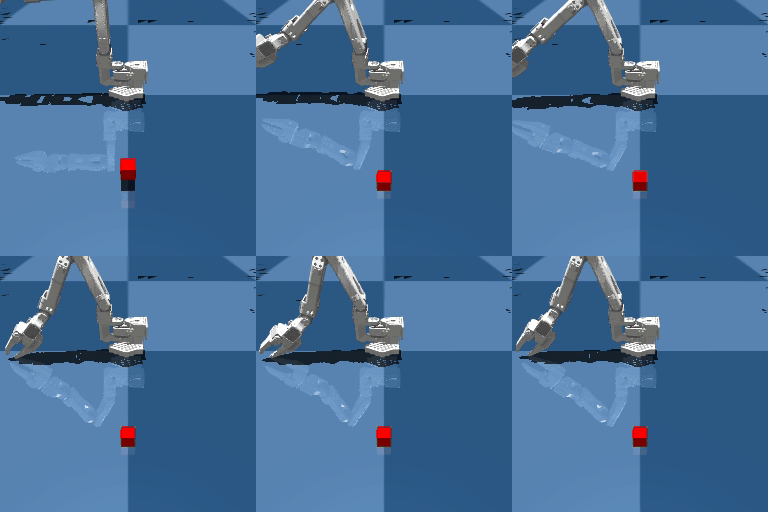
A SmolVLA-on-SO-101 rollout recorded through the run_policy tool's video=
config (MuJoCo headless, MUJOCO_GL=egl).
Multi-episode recording
A recording session is one dataset. The simplest way to collect N episodes in
one session is run_policy(n_episodes=N) - it runs N rollouts back-to-back,
flushes a dataset episode boundary after each, and resets the sim between
episodes for you:
sim.start_recording(repo_id="user/my_dataset", task="pick up the cube", fps=50)
sim.run_policy(robot_name="so100", instruction="pick up the cube",
               policy_provider="mock", n_steps=60, n_episodes=20)
sim.stop_recording()
# -> 20 episodes, each with its own episode_index / length / from_index / to_index
n_steps (or duration) is the per-episode horizon. reset_between=False
chains episodes from the previous end state instead of resetting. When a seed
is given it is offset per episode (seed + i) for reproducible-yet-distinct
rollouts, and a video={...} config is written per episode to a path with
_ep{i} inserted before the extension so episodes do not overwrite one another.
The aggregate result carries n_episodes_completed, episodes_saved,
total_steps, and a per-episode list in its {"json": {...}} block.
If you need full control over each rollout (different instructions, custom
randomization, conditional logic between episodes), drive the loop yourself and
call save_episode() after each rollout to flush it as its own episode:
sim.start_recording(repo_id="user/my_dataset", task="pick up the cube", fps=50)
for _ in range(20):
    sim.reset()
    sim.run_policy(robot_name="so100", instruction="pick up the cube",
                   policy_provider="mock", n_steps=60)
    sim.save_episode()        # flush this rollout as one episode
sim.stop_recording()          # flushes any trailing rollout automatically
save_episode is idempotent on an empty buffer, so it is safe to call
unconditionally inside a loop. LeRobot computes stats.json per episode and then
aggregates, so per-rollout boundaries keep dataset statistics correct across the
reset() teleport between rollouts.
reset() is itself an episode boundary during a recording: if frames are
buffered when you call it, reset() flushes them as their own episode before
re-initializing the world (it reports the saved episode in its result text).
This means a bare run_policy + reset collection loop already produces one
episode per rollout - the explicit save_episode() is optional when you reset
between rollouts:
sim.start_recording(repo_id="user/my_dataset", task="pick up the cube", fps=50)
for _ in range(20):
    sim.run_policy(robot_name="so100", instruction="pick up the cube",
                   policy_provider="mock", n_steps=60)
    sim.reset()               # flushes this rollout as one episode, then resets
sim.stop_recording()          # flushes any trailing rollout automatically
# -> 20 episodes
Without n_episodes, an explicit save_episode(), or a reset() between rollouts, all
20 rollouts append to the same buffer and stop_recording flushes them as a
single episode_index=0 (1200 steps in one episode). To DISCARD a partial
rollout instead of flushing it on the next reset(), call
clear_episode_buffer() first.
Every backend cuts the boundary: reset() asks one shared rule, so the loop
above yields 20 episodes on MuJoCo, Newton and Isaac alike. The one exception is
a partial Isaac reset - reset(env_ids=[...]) re-initializes only the named
environments, and whether the recorded robot's rollout ended is not knowable
from env_ids, so no boundary is cut and the buffer stays open. Call
save_episode() yourself if a partial reset does end the episode you are
recording.
Verifying episode count
An LLM agent narrating "20 episodes recorded" is not proof: a single
run_policy(n_episodes=1) (or 20 looped tool calls into one open buffer)
produces one merged episode_index=0 mega-episode while the agent believes it
recorded 20. Never trust agent narration for dataset structure - verify against
the on-disk metadata. After stop_recording, call verify_dataset_episodes:
sim.stop_recording()
result = sim.verify_dataset_episodes(expected=20)
assert result["status"] == "success"   # else MISMATCH, fail loud
It checks two independent sources of truth and requires them to AGREE:
- the parquet under
meta/episodes/**/*.parquet(the distinctepisode_indexset - the ground truth), and - the
total_episodesheader inmeta/info.json.
status is "error" when the parquet count differs from expected OR when the
parquet disagrees with info.json (an internally inconsistent dataset, e.g. an
interrupted finalize - sources_agree is then False), so a dataset that
happens to match expected on one source but not the other still fails. The
{"json": {...}} block carries expected, actual, info_total_episodes,
info_problems, sources_agree, episode_indices, and total_frames for
programmatic CI gating. The pure-pyarrow read_dataset_episode_indices(root)
exposes the same facts without instantiating a LeRobotDataset.
A header that is present but is not a count at all - 2.5, "2", true, or a
JSON number outside double range such as 1e400 (which json.load parses to
inf) - is a THIRD outcome, distinct from both a matching count and an absent
header: info_total_episodes is None, the reason lands in info_problems, and
sources_agree is False. Such a header is never coerced to a nearby number,
because int(2.5) is 2 - exactly the count a two-episode parquet holds, so
coercing it would certify the inconsistent dataset. Every reader of that header
(this facade, verify-dataset, read_dataset_episode_indices, and the
training-side validation split) shares one domain,
strands_robots.utils.declared_count, so one file cannot get two verdicts.
The same check runs from the shell against any LeRobot dataset on disk, with an exit code suitable for CI:
strands-robots verify-dataset /path/to/dataset --expected 20   # exit 0 pass, 1 fail
strands-robots verify-dataset /path/to/dataset --json          # machine-readable report
strands-robots verify-dataset /path/to/dataset --no-check-videos  # skip the per-episode MP4 checks
verify-dataset reuses the same pure-pyarrow read_dataset_episode_indices
helper (no lerobot import) and flags five failure modes: the mega-episode
(fewer distinct episodes than --expected), meta/info.json total_episodes /
total_frames drifting from the parquet ground truth - or declaring something
that is not a count at all - (caught even without --expected), any episode below --min-frames (default 1), - unless
--no-check-videos is passed - any per-episode video file that is missing or
empty on disk, and - unless --no-check-stats is passed - a dead control
column. The video check is the video-modality sibling of the
mega-episode class: a dataset can carry the right episode count yet have no
pixels because the recorder's video encoder failed or the MP4 streams were
never written. It resolves each camera's MP4 from meta/info.json's
video_path template and the episode parquet's videos/<key>/chunk_index /
file_index columns, and reports the count it checked in
video_files_checked. The programmatic form is
strands_robots.verify_dataset.verify_dataset(root, expected=None, min_frames=1, check_videos=True, check_stats=True),
which returns the same report dict.
The dead-control-column check is the proprioceptive sibling: correct counts and
pixels, but the action (or observation.state) column was written as all
zeros because the writer's keys never resolved to the declared columns. It reads
the per-episode min/max stats LeRobot v3 writes inline, so it needs no video
decode and no data/ scan.
A multi-robot recording is graded one level finer, per robot. start_recording
gives every robot its own state/action columns and namespaces each declared name
with the robot's instance name (alice__shoulder_pan), so a resolution failure
that affects one robot alone leaves that robot's whole block of columns zero
while the other robot's columns carry real measurements. The vector as a whole
therefore still varies, and a whole-vector test reports [PASS]. The check
splits the vector into the per-robot blocks meta/info.json declares and flags
any block that is wholly zero, naming the robot:
feature 'observation.state' is identically zero for every 'bob' column across
episode 0 (20 frame(s)) - dead control column block
A zero subset of one robot's block is left alone - a gripper parked at zero for a whole episode is a measurement, not a writer fault - and a dataset that declares no column names is graded by the whole-vector rule exactly as before.
--expected and --min-frames are both non-negative integers, and each has a
meaningful 0: --expected 0 asks that a dataset be empty, and --min-frames 0
skips the per-episode length check (useful when the writer omits the length
column). Anything else - a negative threshold, a fraction, a non-finite value -
is reported as a problem and exits non-zero, rather than being applied. That
matters for --min-frames specifically: the length check runs only when the
threshold is above zero, so a value that is not a usable count would otherwise
switch the check off and certify a dataset holding a zero-length episode. The
same domain backs verify_dataset_episodes(expected=...), so neither surface
accepts an episode count the other refuses.
The dataset can switch that check off the same way the threshold could: the
length check runs only when the parquet carries per-episode lengths at all, and
availability is whether a length was read, not whether one was positive. A
run that wrote three episodes of zero frames is graded and named
(3 episode(s) below min_frames=1), and its meta/info.json total_frames is
still compared against the zero the parquet holds - previously the whole-run
corruption read as "this writer omits the length column" and passed while the
strictly better [5, 0, 0] failed. A column that is absent, or present but
wholly null, remains unavailable: a length nobody recorded is unknown, not zero,
so neither gains a zero-length verdict.
verify-dataset always produces a report - it never crashes on the corruption
it exists to flag. A corrupt or foreign meta/episodes parquet, a non-v3
video_path template, or a truncated / unreadable MP4 is reported as a problem
string in the report (and a non-zero exit code), not surfaced as a raw
traceback.
Corruption confined to SOME episode parquet shards (the usual outcome of an
interrupted rsync or hub download) is localised rather than fatal: each
unreadable shard is named as a problem, the readable shards still supply
total_episodes / frames_per_episode, and the info.json, video, and
dead-column checks still run against them. Only a meta/episodes tree with no
readable shard at all reports zero episodes. The same holds for
verify_dataset_episodes, which additionally refuses to certify a dataset with
unreadable shards even when the readable count matches expected - the count is
then only a lower bound, reported in the unreadable_files diagnostics.
Recording paths
| Method | Extra needed | Output |
|---|---|---|
start_recording / stop_recording |
[lerobot] |
LeRobot v3 (parquet + MP4) |
save_episode |
[lerobot] |
Close current rollout as one episode (call once per run_policy for N episodes) |
start_cameras_recording / stop_cameras_recording |
[sim-mujoco] alone |
Plain MP4, no parquet |
stop_cameras_recording returns a verdict, not just a report. Two things stop
it finishing, and both answer the same way: a structured error carrying
stopped: False and the per-camera buffered frame counts, no MP4 written, and
the recording left registered so a later call can still encode it.
The first is a join that expires. The daemon recorder runs in its own thread, so
the stop asks that loop to exit and waits 5 s for it; if the loop is still inside
render when the budget runs out -- a wedged GL context, an EGL device that
stopped answering -- reading a buffer it may still append to is refused rather
than encoded.
The second is a flush with no encoder to call. imageio comes with
[sim-mujoco], but [sim-newton] and [cosmos3-sim] bring mujoco without
it, and neither start verb probes the encoder, so the flush is the first call
that needs one. It reports before opening any writer, so every buffer is intact
and installing the encoder and calling again writes them.
"No encoder" covers two modules, not one: imageio declares the plugin that
actually writes MP4 -- imageio_ffmpeg -- as an optional extra of its own, so an
install can have imageio and still no MP4 writer. The flush requires both, and quotes whichever is missing, so
the remedy it prints is the one that works:
'imageio_ffmpeg' is required for MP4 video encoding (encode_clip)
Install with:
  pip install 'strands-robots[sim-mujoco]'
  pip install imageio-ffmpeg
result = sim.stop_cameras_recording()
if result["status"] == "error":
    # Nothing was encoded -- either the loop is still capturing (an MP4 read
    # from a buffer that is still growing would not describe either frame list)
    # or there is no encoder installed. Either way the frames are still there
    # and the recording is still registered, so calling again flushes them.
    result = sim.stop_cameras_recording()
Only a flush deregisters a recording, so being registered is exactly what "holds
frames nobody has encoded" means -- and that is what both start verbs check.
start_cameras_recording and start_cameras_recording_synchronous refuse a new
recording for as long as the old one is registered, whether or not its thread is
still alive: while it is, starting would put a second thread on the same cameras,
and once it has exited, starting would silently discard the frames the failed
stop just promised were recoverable. Retrying the stop is the remedy in both
cases, and on a recording whose loop has exited it joins immediately and encodes.
That registration is published before the capture thread is started, so the check
also covers two starts racing each other: there is no window in which a thread is
capturing while get_cameras_recording_status answers [idle] and
stop_cameras_recording reports "Was not recording cameras" as a success. If the
capture thread cannot be started at all, the recording is deregistered again and
start_cameras_recording returns a structured error naming it, rather than
leaving behind a registration that only a flush could clear.
get_cameras_recording_status reports which of the four phases holds, in its
text and as phase in its JSON block:
phase |
running |
thread_alive |
Meaning |
|---|---|---|---|
recording |
True |
True |
Capturing normally. |
stopping |
False |
True |
A stop's join expired; frames can still land. |
unflushed |
False |
False |
The loop has exited, frames still unencoded -- stop again to flush. |
idle |
- | - | Nothing registered; there is no buffer left to encode. |
[idle] is therefore a promise that nothing is pending, which is why the
settled-but-registered state gets its own name instead of borrowing it.
The Isaac backend exposes the same pair. It captures through the on_frame hook
start_cameras_recording returns rather than a daemon thread, so it has no join
to expire and none of the thread-dependent phases above. The encoder-absence rule
is the same one, and both recorders word it from one place
(encoder_absent_flush_refusal): nothing is encoded and nothing is dropped, the
refusal carries stopped: False with the per-camera buffered counts, the
recording stays registered, and installing the encoder and calling
stop_cameras_recording again encodes the frames it kept. A start is refused for
as long as those frames are registered, for the same reason.
fps, width, height and max_frames_per_camera on the plain-MP4 recorders
must be positive whole numbers - the same domain run_policy(video={...}),
start_recording(fps=...) and the shared encoder
strands_robots.rendering.encode_clip enforce. An unusable value (fps=0, a
negative frame cap) is a structured error naming the parameter rather than a
recording that reports success and writes no file. Omit width/height to use
each camera's configured resolution.
Encoding frames directly through encode_clip(frames, path, fps=...) follows the
same rule and raises ValueError for a rate it cannot honor - a fractional or
non-positive fps previously produced a clip at some other rate (the GIF writer
clamped it to 1 fps, ffmpeg substituted its own default) or no file at all, with
the output path still returned. encode_clip also raises RuntimeError when the
encoder wrote no clip despite accepting the frames, so a returned path always
names a clip that exists.
encode_clip's quality is a finite number in [1, 10] (higher is better), and
that domain holds for both containers even though only the MP4 writer reads the
value - so one call does not become valid by changing the output extension. The
bound is the encoder's own: 0 is refused despite older documentation offering
0-10, and True is refused rather than acting as a silent quality of 1, the
lowest offered. A NumPy real such as np.int64(8) is accepted and converted,
since the ffmpeg writer only recognises a plain int/float. The refusal is a
ValueError from encode_clip rather than the encoder's own assert, so it
does not disappear when Python runs with -O:
from strands_robots.rendering import encode_clip

encode_clip(frames, "clip.mp4", fps=30, quality=9)   # a usable quality
encode_clip(frames, "clip.mp4", fps=30, quality=0)   # ValueError: quality must be between 1 and 10
Video codec (H.264 default, AV1 opt-in)
start_recording (and DatasetRecorder.create/resume) default to
vcodec="h264". H.264 is universally decodable - including by OpenCV's
cv2.VideoCapture, which is what many downstream VLM video readers use to
watch a recorded episode. The recorded per-camera MP4s therefore reopen and
decode everywhere without a transcode step:
import cv2
cap = cv2.VideoCapture(".../videos/observation.images.base/chunk-000/file-000.mp4")
ok, frame = cap.read()   # H.264: ok is True, frame is a real (H, W, 3) array
Pass vcodec="libsvtav1" to opt into AV1 for smaller files in
storage-constrained training pipelines. AV1 reads back fine through LeRobot's
own loader (torchcodec/pyav), but OpenCV wheels commonly lack an AV1 decoder
and silently yield 0 frames (VideoCapture.read() returns False
immediately even though the stream has frames) - so avoid AV1 if anything in
your pipeline reads the videos through OpenCV.
The flat vcodec value accepts either codec names (h264, hevc,
libsvtav1) or ffmpeg encoder names (libx264, libx265); it is normalized
to whatever the installed LeRobot version's encoder config expects. An
unsupported codec fails loudly rather than silently reverting to the default.
DatasetRecorder direct API
from strands_robots.dataset_recorder import DatasetRecorder

recorder = DatasetRecorder.create(
    repo_id="user/my_dataset",
    fps=30,
    robot_type="so100",
    # When recording from a real LeRobot hardware robot pass the schema dicts
    # straight through:
    #   robot_features=robot.observation_features,
    #   action_features=robot.action_features,
    # When recording from a sim Robot (no `observation_features` attr), pass
    # `joint_names=[...]` instead - the recorder builds the schema for you.
    # The names must be the observation's own keys: for the so100 sim these
    # are Rotation, Pitch, Elbow, Wrist_Pitch, Wrist_Roll, Jaw - i.e.
    # `list(sim.get_observation()["so100"].keys())`. A declared name that a
    # frame's observation (or action) does not carry - absent, or present as
    # `None` - makes `add_frame` raise; nothing is recorded as a stand-in 0.0.
    camera_keys=["default"],
    joint_names=["Rotation", "Pitch", "Elbow", "Wrist_Pitch", "Wrist_Roll", "Jaw"],
    task="pick up the red cube",
    # root=None → $HF_LEROBOT_HOME/user/my_dataset
    # vcodec="h264", streaming_encoding=True, image_writer_threads=4
)

for step in control_loop:
    recorder.add_frame(observation, action, task="pick up the red cube")
recorder.save_episode()
recorder.finalize()
recorder.push_to_hub(tags=["so100", "sim"], private=False)
Append to existing dataset (requires lerobot>=0.5.2):
recorder = DatasetRecorder.resume(repo_id="user/my_dataset", task="pick up the blue cube")
# root=None -> $HF_LEROBOT_HOME/user/my_dataset, the directory create() wrote to
recorder.add_frame(observation, action)
recorder.save_episode()
recorder.finalize()
A failed import names the install that fixes it
create() and resume() import lerobot.datasets.lerobot_dataset, which fails
for four unrelated reasons that need four different instructions - so the
ImportError says which one happened, exactly as every backend's
start_recording does:
| Cause | What the error says to do |
|---|---|
| lerobot itself is absent | pip install 'strands-robots[lerobot]' |
lerobot is installed, but a package its dataset stack needs (datasets, pandas, pyarrow, av, torchcodec) is not |
pip install 'lerobot[dataset]' - installing lerobot alone does not pull those in |
| lerobot is installed but does not provide that module (an out-of-range or from-source lerobot) | pip install 'strands-robots[lerobot]', which pins the supported range |
| the import failed with nothing missing (a binary conflict between installed packages) | No install fixes it; reconcile the conflicting packages |
Schema column names must be distinct
camera_keys, joint_names and action_names each declare the recorded
dataset's column names, so each must be a list of distinct, non-blank names.
create() refuses anything else before it touches the on-disk target, so a
refused overwrite=True call leaves an existing dataset intact:
DatasetRecorder.create(repo_id="user/d", joint_names="gripper")     # ValueError
DatasetRecorder.create(repo_id="user/d", camera_keys=["front", "front"])  # ValueError
Both mistakes used to be accepted and only surfaced in the recorded data:
- A single name passed as a bare string is iterable per character, so
joint_names="gripper"declared seven columns (g,r,i,p,p,e,r).add_framereads each declared name out of the observation, and none of those names is in it, so every column recorded0.0for the whole episode -create(),add_frame(),save_episode()andfinalize()all succeeded. Wrap a single name in a list:joint_names=["gripper"]. - A repeated name collapses where it keys a dict and doubles where it indexes
a position.
camera_keys=["front", "front"]declared one camera column for the two the caller asked for;joint_names=["j1", "j2", "j2"]recordedj2twice and the joint the caller meant not at all.
None and [] still mean "not supplied" - the schema is then derived from
robot_features / action_features, or from joint_names for the action
columns.
Camera frame shape must be a usable pixel count
camera_dims and the video_width / video_height pair are one quantity in two
spellings: the recorder declares each camera at
camera_dims.get(camera, (video_height, video_width)), so the mapping sets the
shape of the cameras it covers and the pair sets the shape of every other one.
Note the order - camera_dims is (height, width), the reverse of the pair.
It is a declaration, not a resize - the recorder rescales nothing - so
whatever is given goes straight into the LeRobot feature as
(height, width, 3) with names [height, width, channels] - the layout
lerobot itself records and every published v3 dataset uses.
create() refuses a shape it cannot honor, on the same shared domain and in the
same place as the column names above:
DatasetRecorder.create(repo_id="user/d", camera_keys=["image"],
                       camera_dims={"imagee": (240, 320)})   # ValueError: not a declared camera
DatasetRecorder.create(repo_id="user/d", camera_keys=["image"],
                       camera_dims={"image": (240,)})        # ValueError: not a (height, width) pair
DatasetRecorder.create(repo_id="user/d", camera_keys=["image"],
                       video_width=0)                        # ValueError: must be a positive integer
Three mistakes used to be accepted, and none was reported near the parameter that caused it:
- A key
camera_keysdoes not declare is never looked up, so the camera it was meant for silently took the global pair instead. A camera streaming 240x320 declared ascamera_dims={"imagee": (240, 320)}againstcamera_keys=["image"]was declared(3, 480, 640)from the defaults - nothing logged, dataset created, and the mismatch surfacing later againstadd_frame. - A component that is not a positive integer was written in as given, so the
schema declared
(3, 480, nan)or(3, 480, '640')and no frame could match it. A pixel count is written intometa/info.json, so it has to be a trueint: an integral float would be declared as480.0, and a NumPy integer is not JSON-serializable. - A value that is not a two-element sequence unpacked as a bare
TypeError, and a non-mappingcamera_dimsas a bareAttributeErrorfrom the lookup.
camera_dims=None and {} still mean "not supplied" - every camera then takes
the global pair. Passing the shape as a list rather than a tuple is accepted.
The recording rate must be a usable frame count
fps is the rate the dataset is declared at - it is written into
meta/info.json and every timestamp is derived from it positionally - so
create() holds it to the same positive-whole-number domain every backend's
start_recording(fps=...) already applies to the rate it forwards here:
DatasetRecorder.create(repo_id="user/d", fps=2.7)    # ValueError: fps must be a positive whole number
DatasetRecorder.create(repo_id="user/d", fps=float("nan"))   # same refusal
DatasetRecorder.create(repo_id="user/d", fps=True)   # refused, not read as 1 fps
LeRobot rejects only fps <= 0, so everything above used to be accepted by the
direct API and cost the caller the episode without reporting anything: a
fractional 2.7, a nan or an inf created the dataset and then saved zero
frames, with create, add_frame, save_episode and finalize all returning
normally. fps=True recorded a 1 fps dataset (an int subclass acting as a 1),
and fps="30" dead-ended in a bare TypeError naming neither the parameter nor
the method.
The rule is the facades' rule by construction - one shared domain, reached from
both - so a rate start_recording accepts cannot be refused deeper. A rate that
disagrees with a rollout's control_frequency is a separate check that only the
facades can make (see fps must equal the rollout's
control_frequency); create()
judges the rate on its own terms.
A posture flag must be a boolean
use_videos, streaming_encoding and overwrite select a branch rather than
scaling a quantity, so create() holds them to the shared boolean domain - the
one every backend's start_recording already applies to the overwrite it
forwards here, and the one push_to_hub(private=...) and sync_to_bucket()
apply to their own flags. resume() checks the streaming_encoding it forwards
on the same domain:
DatasetRecorder.create(repo_id="user/d", overwrite="false")   # ValueError: overwrite must be a boolean
DatasetRecorder.create(repo_id="user/d", use_videos="no")     # same refusal
DatasetRecorder.resume(repo_id="user/d", streaming_encoding=0)  # same refusal
Read by truthiness, every non-empty string is truthy, so the spellings a caller
reaches for when opting out selected the branch they were opting out of.
overwrite is a confirmation gate in front of a delete, so it was the expensive
one: overwrite="false" (also "no", "off", "0") removed the existing
dataset - a dataset holding one recorded episode came back holding zero, and
create() returned a working recorder throughout. use_videos="false" declared
every camera as dtype="video" where False declares "image", a schema
decision written into meta/info.json and fixed for the life of the dataset, and
the same unconverted string then reached LeRobot's own boolean parameter, as
streaming_encoding="false" did.
The check runs in the same guard block as the schema and rate checks above - before the lerobot extra is probed and before the on-disk target is touched - so a refused flag cannot remove a dataset on the way to being reported.
Re-recording into an existing repo_id
DatasetRecorder.create() builds a fresh dataset. If the resolved dataset
directory already exists, LeRobot's create() would raise a bare
FileExistsError (its mkdir uses exist_ok=False). create() resolves this
up front, matching the start_recording facade:
overwrite=Truewipes the existing directory and creates a fresh dataset.overwrite=False(default) on an existing dataset (a dir containingmeta/) raises a clearFileExistsErrornamingoverwrite=True(fresh) andresume()(append) - not a cryptic LeRobot error, and never a silent clobber.- An existing empty directory (e.g. from
tempfile.mkdtemp()) is cleared socreate()does not dead-end on its own existence guard. - A non-empty non-dataset directory raises
ValueErrorrather than deleting unrelated files. overwritemust be a boolean (see A posture flag must be a boolean), checked before the target is touched, so a value that is not one cannot delete a dataset.
# Re-run a capture script into the same repo_id, replacing the old dataset:
recorder = DatasetRecorder.create(
    repo_id="user/my_dataset", fps=30, joint_names=[...], overwrite=True,
)
Use resume() (not create(overwrite=True)) when you want to append
episodes to the existing dataset instead of replacing it.
A frame the recorder cannot write fails the rollout
DatasetRecorder is fail-fast by default (strict=True): if the underlying
LeRobotDataset write fails, it raises
strands_robots.dataset_recorder.RecordingFrameError instead of continuing. When
the recorder is driven by run_policy, that ends the rollout with
status="error" naming the frame the recording stopped being complete at:
Policy failed: dataset add_frame failed after 7 frame(s) written; the recording
is incomplete from this frame on (strict=True, so it is not dropped silently):
<the underlying error>
Continuing past a lost frame is not a smaller failure. Timestamps are derived
positionally from the declared fps, so the surviving frames are re-stamped into
a shorter span than they were captured over - a rollout that loses every other
frame at 50 Hz produces an episode labelled at 2x speed, with no gap to detect.
Construct the recorder with strict=False to trade that for best-effort
recording: a failed write is counted in dropped_frame_count, warned about at
WARNING (on the 1st, 2nd, 4th, 8th ... failure so a 50 Hz loop cannot flood the
log), and the rollout continues.
stop_recording is where those counted drops reach the caller, and it is the
last chance: it releases the recorder as it returns, so a count it does not
report is a loss nothing can measure afterwards. It reports them two ways.
Some writes failed - the session stays a success (strict=False chose to
complete) that says how short it is, in the text and in dropped_frame_count
beside frame_count:
Episode saved to LeRobotDataset
local/flaky -- 10 frames, 1 episode(s)
10 frame(s) failed to write and were dropped (strict=False): the dataset holds
10 of the 20 frames recorded
Every write failed - the dataset is empty for that reason, so the
empty-dataset refusal below names it instead of the loop classification, which
would prescribe the start_recording -> run_policy -> stop_recording recipe
this caller had just followed:
stop_recording: all 20 frame(s) the recorder was fed failed to write, so the
dataset holds 0 frames. The recorder was built with strict=False, which drops a
failed write and counts it in dropped_frame_count instead of raising - which is
why the rollout reported success. ...
strict must be a boolean - it selects a posture, so it is checked on the same
domain as use_videos / streaming_encoding / overwrite rather than read by
truthiness, and a value outside it is a ValueError from the constructor:
DatasetRecorder(dataset=ds, strict=None)      # ValueError: strict must be a boolean
DatasetRecorder(dataset=ds, strict="false")   # ValueError: strict must be a boolean
Read by truthiness these inverted in both directions. Every falsy non-boolean
(None, 0, "", []) selected best-effort recording without ever being a
declared spelling of it, so a run that lost a quarter of its frames completed and
reported success; and every non-empty string is truthy, so strict="false" - the
spelling reached for to opt out - selected fail-fast and then named strict=True
in the message above whatever the caller wrote.
A declared camera every frame leaves empty is refused by name
A frame is graded against the schema in both directions. An observed camera the
schema does not declare is dropped, so an extra debug view cannot fail the
write. The mirror case is not survivable: LeRobot's validate_frame reports a
declared feature a frame omits as Missing features and rejects the frame, and
because camera names do not change between steps it rejects every frame of
the episode - nothing is recorded at all.
That is refused at add_frame, naming the declared column left empty, the
observed stream that was dropped, and the remedy:
Recorded image column(s) ['wrist'] carry no image in this frame, while the
observed camera stream(s) ['wrist_cam'] are not declared. LeRobot refuses a
frame that leaves a declared feature empty, so this frame - and every later
one, the camera names do not change - cannot be recorded. Pass
camera_key_map={'wrist_cam': 'wrist'} to remap, or declare cameras whose names
match the streams.
The condition is a declared column with no image, not how many observed streams matched. Getting two camera names of three right is the likeliest version of this mistake and used to be the quiet one - the recording died on LeRobot's report, which names the dataset column but neither camera name nor the remap that reconciles them. A scene streaming an extra camera alongside a full set of declared ones is unaffected and stays silent.
This is the camera sibling of the state and action column refusals: a declared column is a promise the frame has to keep, whatever kind of column it is.
An episode the recorder cannot flush stops a recorded evaluation
save_episode is the episode-level counterpart, and a failed flush is worse than
a lost frame rather than milder. The recorder marks itself closed, because the
LeRobot episode buffer is in an undefined state after a partial write - and
add_frame returns immediately on a closed recorder, without writing a frame,
without raising RecordingFrameError, and without counting a
dropped_frame_count. Every later episode is therefore discarded in silence,
leaving no trace even in the recorder's own accounting.
So every flush refuses rather than continues. save_episode() and
stop_recording() drop the poisoned recorder and return status="error",
run_policy(n_episodes=N) aborts its remaining episodes - both the
Simulation.run_policy facade and the run_policy tool, which owns that
loop on the facade's behalf and reports the reason as recording_save_error
beside its parquet-truth counts - reset() surfaces the
failure instead of resetting into an undefined state, and a recorded
eval_policy / evaluate_benchmark - one driven with an on_frame hook that
calls add_frame, which is the only way those two feed a recorder - stops at the
episode whose flush failed and reports the reason:
result = sim.eval_policy(robot_name="so100", n_episodes=20, on_frame=hook)
payload = next(b["json"] for b in result["content"] if "json" in b)
if payload["recording_save_error"]:      # None on every healthy evaluation
    ...   # status is "error"; episodes_completed is the episode it stopped at
episodes_completed and success_rate then cover only the episodes that ran, so
an aggregate is never reported over episodes whose frames reached no dataset. The
run_policy tool reports the same way: n_episodes_ok counts the rollouts that
happened rather than the ones requested, only their MP4s appear in video_paths,
and its FABRICATION GUARD warning names the flush that failed rather than
reporting the boundary as one that never fired.
Instance methods
| Method | What |
|---|---|
add_frame(observation, action, task=None, camera_keys=None) |
Append one timestep |
save_episode() |
Flush buffer as a new episode |
clear_episode_buffer() |
Discard current episode |
finalize() |
Write metadata, stats, close writers |
push_to_hub(tags=None, private=False) |
Upload to a versioned HF dataset repo. private selects the published repo's visibility, so it must be a boolean — a truthy spelling of off such as "false" would otherwise select the opposite posture |
sync_to_bucket(bucket, run_id=None, private=True) |
Sync to a mutable HF Storage Bucket (hf://buckets/...) — Xet-deduped collection target; needs the hf CLI. bucket (name or org/name) and run_id (single segment) are allowlist-validated ([A-Za-z0-9._-], no traversal) before the sync, and create / private / delete must each be a boolean — delete mirror-deletes remote files absent locally, so a truthy "false" must not select it |
sync_to_bucket needs the hf CLI with the buckets/sync subcommands
(pip install -U "huggingface_hub>=1.5" + hf auth login - those subcommands
first ship in 1.5.0; every earlier release, including 1.0-1.4.x, installs an
hf entry point without them).
sync_to_bucket is the recorder's own method, so it needs the live session.
Any dataset directory already on disk - recorded earlier in the process, or on
hardware via lerobot-record - syncs (or re-syncs daily) through the
module-level helper instead:
from strands_robots import sync_dataset_to_bucket

sync_dataset_to_bucket("/tmp/demo", "your-org/robot-fave")
# -> {"status": "success", "bucket_uri": "hf://buckets/your-org/robot-fave/demo"}
run_id defaults to the directory name; pass run_id="nightly" to choose the
bucket subpath, and delete=True for mirror semantics.
Read back
Fully materialized (downloads everything):
from lerobot.datasets.lerobot_dataset import LeRobotDataset

ds = LeRobotDataset(repo_id="user/my_dataset", root="/tmp/my_dataset")
print(len(ds), ds[0].keys())
Replay an episode
sim.replay_episode(repo_id, robot_name=..., episode=0, root=None, speed=1.0)
plays a recorded episode back through the sim: each recorded frame is one
control step, applied via send_action and integrated for a full control period
derived from the dataset fps, so a position-servo robot reproduces the recorded
trajectory. speed scales only the wall-clock playback rate. robot_name
follows the rule run_policy, eval_policy and evaluate_benchmark share:
omit it in a sole-robot scene, name it in a scene holding several (an omitted
name there is refused with the candidate list rather than replayed onto the
first robot), and a name the scene does not hold - the empty string included -
is reported by name rather than replaced.
root is resolved from repo_id exactly as recording resolves it, so whatever
id start_recording was given replays with nothing restated:
sim.start_recording(repo_id="sim_recording", task="pick the cube", fps=30)
...
sim.stop_recording()
sim.replay_episode("sim_recording", robot_name="so101")   # same id, same directory
Each recorded action index is bound to an action key. By default those are
robot_action_keys(robot_name) — the robot's actuator keys, which is the
ordering the recorder writes the action column in. Pass action_key_map only
when the dataset's action ordering differs:
sim.replay_episode(
    "user/my_dataset",
    robot_name="so101",
    root="/tmp/my_dataset",
    action_key_map=["1", "2", "3", "4", "5", "6"],  # one key per action index
)
action_key_map must be a non-empty list/tuple of unique strings whose length
equals the recorded action vector's width. A bare string (consumed one key per
character), a non-string entry, a duplicate key, or a width mismatch is rejected
with an actionable error before the dataset is fetched — never truncated to fit.
A "success" status means at least one recorded action reached the actuators and
every frame that carried one was applied; frames_with_action reports how
many of frames_applied commanded the robot rather than only advancing physics.
If a recorded action cannot be applied — e.g. the mapped keys resolve to no
actuator on this robot — the replay aborts at that frame and returns
status="error" with the frame index, how many frames were applied, and the
unresolved keys:
result = sim.replay_episode("user/my_dataset", robot_name="so101", action_key_map=["wrong"] * 6)
result["status"]                                  # "error"
result["content"][1]["json"]["unresolved_keys"]   # ['wrong', ...]
result["content"][1]["json"]["frames_applied"]    # 0
An episode whose frames carry no action column aborts for the same reason —
every frame would take the tolerated no-action branch, advancing physics while
commanding nothing, and Frames: N/N would read exactly like a replay that
worked. The refusal names the columns the frames do carry, which is the signal
when the recorded actions live under another name:
result = sim.replay_episode("user/observations_only", robot_name="so101")
result["status"]                                     # "error"
result["content"][1]["json"]["frames_with_action"]    # 0
result["content"][1]["json"]["recorded_columns"]      # ['observation.state', 'task']
Stream back (no full download)
sim.stream_dataset() is the in-process counterpart to start_recording /
stop_recording — it reads frames lazily from the Hub (or a local root) via
LeRobot's StreamingLeRobotDataset. Camera frames are decoded on the fly from
the MP4 shards; state/action come from the parquet shards.
from strands_robots import Robot

sim = Robot("so100")
reader = sim.stream_dataset(
    "user/my_dataset",                 # a path-like repo_id needs no root=
    root="/tmp/my_dataset",
    delta_timestamps={                 # optional: stacked time windows + *_is_pad masks
        "observation.state": [-0.0667, -0.0333, 0.0],
        "action": [0.0, 0.0333, 0.0667],
    },
    buffer_size=1,                     # capture order for replay/eval:
    max_num_shards=1,                  # one reservoir slot, one shard
)
print(reader.num_episodes, reader.num_frames, reader.fps)
for frame in reader:
    ...

# torch DataLoader (shuffles INTERNALLY — do not pass shuffle=True):
for batch in reader.dataloader(batch_size=64, num_workers=4):
    ...
A repo_id that is itself a path (no owner/name slash, or ./-prefixed) is
resolved to the directory recording wrote to, so the record -> read-back loop
needs no root restated:
sim.start_recording(repo_id="sim_recording", task="pick the cube", fps=30)
...
sim.stop_recording()
reader = sim.stream_dataset("sim_recording")   # ./sim_recording, not the Hub
Equivalently, the standalone reader: from strands_robots import StreamingDatasetReader.
shuffle is not the read-order knob, and shuffle=False on its own reads
shuffled frames with nothing reporting it. It selects only which generator
drives the reordering (a generator reseeded from seed on every exhaustion, or
the dataset's advancing one), so it decides reproducibility across epochs —
lerobot documents it as "whether to shuffle the dataset across exhaustions".
StreamingLeRobotDataset reorders either way: it samples a shard at random per
frame and yields from a reservoir buffer. Capture order is therefore
buffer_size=1 (a reservoir of one cannot reorder) plus max_num_shards=1
(a single shard has nothing to interleave), as above.
Useful kwargs (all forwarded to StreamingLeRobotDataset):
episodes=[...] (subset without download), buffer_size, max_num_shards,
return_uint8=True (default; halves frame bandwidth), and
drop_videos=True (proprio-only — skips video decode entirely, so it works on
edge devices without a torchcodec wheel; requires delta_timestamps with at
least one non-video key, otherwise open() raises ValueError rather than
silently streaming video anyway).
The four numeric kwargs (tolerance_s, buffer_size, max_num_shards,
seed) are checked before the lerobot import: StreamingLeRobotDataset
validates only repo_type and stores the rest verbatim, so every consumer of
them is downstream of a call that already returned. open() raises ValueError
naming the parameter instead - a shard count of 0 used to open successfully
and then stream zero frames, a buffer_size of 0 raised out of NumPy
part-way through iteration, and a tolerance_s of inf switched off the
delta-grid check below. tolerance_s=0 is accepted and means "require an exact
grid match"; seed=0 is accepted and is simply a seed.
The five boolean kwargs (streaming, shuffle, return_uint8,
validate_deltas, drop_videos) are checked there too, on the same domain the
recording postures use (A posture flag must be a
boolean) and for the same reason - read by
truthiness, each selected the branch the caller was opting out of:
reader = sim.stream_dataset("user/d", drop_videos="false")  # ValueError: drop_videos must be a boolean
reader = sim.stream_dataset("user/d", validate_deltas=0)    # same refusal
drop_videos="false" (also "no", "off", "0") is truthy, so it removed
the camera keys from delta_timestamps - the opposite of the opt-out it spells -
and when nothing but camera keys were requested it reported
drop_videos=True requires ..., naming a value the caller had never passed and
pointing at a remedy that lands on the silent proprio-only stream. Falsy
non-booleans took the other branch just as silently: validate_deltas=0 skipped
the delta-grid check, so an off-grid delta_timestamps that validate_deltas=True
refuses opened and streamed; return_uint8=None streamed float32 at ~4x the
bandwidth of the uint8 it spells; and
streaming=0 failed inside LeRobot on num_shards. reader.dataloader(shuffle=...)
needs no such check - it discards the key whatever it held.
Every kwarg is forwarded unconditionally: each lerobot-bearing extra floors
lerobot at 0.6.1, whose StreamingLeRobotDataset accepts all of them —
repo_type included. open() therefore never drops a keyword to suit an older
constructor, which for repo_type would have streamed the versioned dataset
namespace instead of the requested bucket, a different storage system. An
environment carrying a below-floor lerobot gets lerobot's own TypeError
naming the keyword.
For training, the upstream trainer uses the same engine:
lerobot-train --policy.type=act \
  --dataset.repo_id=user/my_dataset --dataset.streaming=true --num_workers=4
(lerobot-train is the entry point over python -m lerobot.scripts.lerobot_train;
flags are draccus --dotted.key=value form.)
macOS: video streaming needs Homebrew ffmpeg on the dyld path.
import
strands_robots
auto-fixes this (zero-touch); disable withSTRANDS_ROBOTS_NO_DYLD_SHIM=1.
See also
- Training - what to do with the data.
- Steerable annotation - add language conditioning columns to a recorded dataset.
- LeRobot dataset docs - upstream spec.