Cosmos 3
uv pip install "strands-robots[cosmos3-service]" # adds msgpack + websockets; no openpi-client needed
from strands_robots.policies import create_policy

policy = create_policy("cosmos3", embodiment="droid", port=8000)
# or: create_policy("cosmos3://localhost:8000")
Start the server
python -m cosmos_framework.scripts.action_policy_server_robolab \
    --checkpoint-path nvidia/Cosmos3-Nano-Policy-DROID --port 8000
# embodiment is selected client-side via create_policy(..., embodiment="droid")
Parameters
Cosmos3Policy(
    embodiment="droid",          # droid | umi | av | bridge | openarm
    host="localhost",         # bare hostname or IP literal; IPv6 bracketed "[::1]"
    port=8000,                   # int in [1, 65535]
    action_space=None,
    observation_mapping=None,
    action_mapping=None,
    robot=None,                  # "franka" or "panda" for built-in DROID→sim mapping
    prompt="",
    api_key=None,
    client=None,
    transport="raw",
    backend="service",          # "service" (default) | "diffusers" (in-process)
    mode="policy",              # "policy" | "forward_dynamics" | "inverse_dynamics" (diffusers only)
    model=None,                 # HF repo id / path for the diffusers backend
)
host and port form the one address this client dials (ws://<host>:<port>)
and are refused before the endpoint is built: host must be a bare hostname or
IP literal (IPv6 bracketed as "[::1]"), because host="localhost/foo" would
parse as port 80 with the configured 8000 in the path. An injected
client= owns its own address, and its read_timeout
(Cosmos3WebsocketClient(host, port, read_timeout=1800), default 600 s, positive
and finite) bounds every read off the live connection - websockets' recv()
has no deadline, so a server that accepted the connection and then went quiet
would otherwise hold the caller forever. An expired read is reported as a
timeout, not as "start the server first", and discards the connection.
A frame that arrives and cannot be read as msgpack+NumPy is a third case,
reported as neither: it names the endpoint, which read it answered (metadata
handshake or action chunk), what the codec could not do, and the frame's
opening bytes. This package serves policies over a WebSocket in two wire
formats, so the common cause is a port mixed up between them - dialling
strands_robots.inference.server, which speaks JSON text frames, with this
client. Telling that apart from an absent server matters because only one of
the two is fixed by starting a server.
Embodiments
Embodiments: droid (10D, chunk 32, 15 fps), umi, av, bridge, openarm
(post-training only). The embodiment is chosen client-side; the server hosts one
Cosmos 3 checkpoint for all of them.
| Embodiment | Robot hardware | Strands sim asset |
|---|---|---|
droid |
Franka / DROID dataset | "panda" or "franka" |
umi |
UMI gripper | - |
av |
Autonomous vehicle cameras | - |
bridge |
Bridge dataset robots | - |
openarm |
Enactic OpenArm (7-DOF + gripper) | "openarm" |
Action spaces
An embodiment serves its action under one or more action_space names, each with
its own columns:
action_space |
Columns | Notes |
|---|---|---|
midtrain |
The model's unified action: tx,ty,tz + the 6D rotation r0..r5 + grasp (omitted for av, which has no gripper) |
Served through un-converted, so the columns are the same as raw_action_layout |
joint_pos |
joint_0..joint_6 + gripper (DROID only) |
The one space the RoboLab server post-processes, converting the effector pose into joint targets |
action_mapping renames a column to one of your robot's actuator names, so its
keys must be columns of the active space ({"grasp": ...} under midtrain,
{"gripper": ...} under joint_pos); a key naming no column is refused listing
the valid ones. It has to be a rename: two columns arriving at one actuator name
would collapse into one step-dict entry and drop a command, so both spellings of
that collision are refused at construction (renaming every column is a
bijection and is accepted).
joint_pos reads seven joint values plus a gripper in the order you declare with
set_robot_state_keys(), as every example here does. Without it the order is
inferred from the observation's scalar keys, position-only: a <joint>.vel
entry is dropped when its <joint> companion is present (every sim backend
emits one), a .vel key with no companion is kept (LeKiwi's x.vel /
theta.vel), and explicit robot_state_keys are never filtered - the same rule
the LeRobot provider applies.
Backends
| backend | how it runs | install | extra outputs |
|---|---|---|---|
service (default) |
WebSocket to the Cosmos Framework RoboLab policy server (holds the GPU out-of-process) | strands-robots[cosmos3-service] (msgpack + websockets, numpy-agnostic) |
none (server video discarded) |
diffusers |
in-process via native diffusers (Cosmos3OmniPipeline) |
strands-robots[cosmos3-diffusers] (floors diffusers 0.39, the first release shipping the pipeline) |
world video + sound on last_rollout |
# in-process backend (heavy GPU stack: diffusers + torch)
uv pip install "strands-robots[cosmos3-diffusers]"
Cosmos3OmniPipeline and CosmosActionCondition first ship in diffusers
0.39.0, which the extra floors; nvidia/Cosmos3-Edge is built against
0.40.0.dev0, which at the time of writing ships only from source:
Loading a checkpoint the installed diffusers cannot build is refused naming the
tensors it could not fill - from_pretrained itself only warns and would run on
random weights. The extra is native diffusers + torch + transformers,
numpy>=2-compatible and co-installable with cosmos3-service.
Action layout note. The
diffusersbackend returns the model's raw unified action (DROID = 9D end-effector posetx,ty,tz,r0..r5+ 1Dgrasp= 10D), named by the embodimentraw_action_layout- the pipeline's native output, before the RoboLab server'sjoint_pos(8D) conversion. Usebackend="service"when you need joint-position commands.Safety checker /
cosmos_guardrail.Cosmos3OmniPipelinebuilds aCosmosSafetyCheckerat load time, which requires the heavy optionalcosmos_guardrailpackage and otherwise raisesImportError: cosmos_guardrail is not installed. The diffusers backend disables it by default (enable_safety_checker=False, passed through tofrom_pretrained) so the pipeline loads without that extra. To re-enable it, installcosmos_guardrailand build the backend withenable_safety_checker=True, then hand that backend to the policy - the flag is aCosmos3DiffusersBackendparameter, not aCosmos3Policyone:from strands_robots.policies.cosmos3.embodiments import get_embodiment from strands_robots.policies.cosmos3.policy import Cosmos3Policy from strands_robots.policies.cosmos3.policy_diffusers import Cosmos3DiffusersBackend backend = Cosmos3DiffusersBackend( embodiment=get_embodiment("droid"), model="nvidia/Cosmos3-Nano", enable_safety_checker=True, # needs cosmos_guardrail installed ) policy = Cosmos3Policy(embodiment="droid", backend="diffusers", diffusers_backend=backend)
Cosmos3Policyforwards onlyembodiment,modelandmodeto the backend, so the same route is how you reach its other load and sampling knobs (resolution_tier,view_point,device,dtype,num_inference_steps,guidance_scale,enable_sound). Note Cosmos runs inbfloat16, so the backend up-casts the half-precision action tensor tofloat32before returning the chunk.
backend="diffusers" — world video alongside the action chunk
One in-process forward pass returns the predicted world video, optional sound,
and the action chunk. The chunk comes back through the normal get_actions
-> list[dict] contract; video and sound are surfaced on policy.last_rollout:
from strands_robots.policies import create_policy

policy = create_policy(
    "cosmos3",
    embodiment="droid",
    backend="diffusers",
    model="nvidia/Cosmos3-Nano",  # HF repo id or local path
)
policy.set_robot_state_keys([f"joint_{i}" for i in range(7)] + ["gripper"])

steps = policy.get_actions_sync(observation, "pick up the red cube")
# steps == [{"tx": .., "ty": .., ..., "r5": .., "grasp": ..}, ...]  (raw unified
# action, one dict per timestep)

# the predicted world video Cosmos rolled out for that action chunk:
print(policy.last_rollout["video"])   # path to an .mp4 / .gif
print(policy.last_rollout["sound"])   # path to a .wav, or None
Action modes (diffusers only)
The diffusers backend exposes Cosmos 3's full physics loop via the mode kwarg
(CosmosActionCondition.mode). These do not exist in service mode - a
non-policy mode under backend="service" raises.
mode |
conditioning | predicts | get_actions returns |
|---|---|---|---|
policy (default) |
first frame + task prompt | future video + actions | action chunk (list[dict]) |
forward_dynamics |
first frame + given raw_actions |
future video | [] (world video on last_rollout) |
inverse_dynamics |
an observed video | the actions between frames | action chunk (list[dict]) |
All three modes are verified live on real nvidia/Cosmos3-Nano weights (Thor,
bf16/CUDA); metrics in docs/assets/cosmos3/live_modes_metrics.json.
# forward dynamics: "what world results if I run these actions?"
fd = create_policy("cosmos3", embodiment="droid", backend="diffusers", mode="forward_dynamics")
fd.set_robot_state_keys([f"joint_{i}" for i in range(7)] + ["gripper"])
fd.get_actions_sync(observation, "", raw_actions=my_action_chunk)
print(fd.last_rollout["video"])   # predicted world rollout

# inverse dynamics: "what actions produced this observed video?"
inv = create_policy("cosmos3", embodiment="droid", backend="diffusers", mode="inverse_dynamics")
inv.set_robot_state_keys([f"joint_{i}" for i in range(7)] + ["gripper"])
steps = inv.get_actions_sync(observation, "", video="observed.mp4")
Closing the sim loop: de-normalize → IK → MuJoCo
The diffusers backend's raw unified action is quantile-normalized to
[-1, 1] and encodes a relative end-effector pose delta per step, not
joint radians - fed straight to MuJoCo joint actuators it is meaningless.
Three geometric steps (cosmos3-sim extra: mink + mujoco, numpy>=2,
co-installable with the other extras) turn it into joint targets:
- De-normalize - invert the quantile transform with the embodiment's
bundled
q01/q99action stats:denorm = 0.5 * (a + 1) * (q99 - q01) + q01(denormalize_quantile). - Decode poses - integrate the per-step
[translation(3), rot6d(6)]deltas into an absolute(T+1, 4, 4)SE3 trajectory anchored at the robot's current EE pose (decode_pose_trajectory, viaMinkIKBridge.ee_pose(qpos), the forward-kinematics call). - Inverse kinematics - solve each Cartesian target with
minkdifferential IK on the samemujoco.MjModel, warm-starting each step (MinkIKBridge).
import mujoco, numpy as np
from robot_descriptions import panda_mj_description
from strands_robots.policies.cosmos3 import (
    Cosmos3Policy, MinkIKBridge, decode_cosmos_chunk_to_targets,
)
from strands_robots.policies.cosmos3.embodiments import get_embodiment

policy = Cosmos3Policy(embodiment="droid", backend="diffusers", model="nvidia/Cosmos3-Nano")
policy.set_robot_state_keys([f"joint_{i}" for i in range(7)] + ["gripper"])
chunk_dicts = policy.get_actions_sync(observation, "pick up the red cube")
raw_chunk = policy.last_rollout["action"]          # [T, 10] raw [-1,1] action

model = mujoco.MjModel.from_xml_path(panda_mj_description.MJCF_PATH)
bridge = MinkIKBridge(model, ee_frame_name="hand", ee_frame_type="body")
q_init = np.zeros(model.nq); q_init[:7] = [0, -0.3, 0, -2.2, 0, 2.0, 0.79]

out = decode_cosmos_chunk_to_targets(raw_chunk, get_embodiment("droid"), bridge, q_init)
out["qpos"]            # [T, nq] joint targets to send to MuJoCo
out["gripper"]         # [T] grasp column (None for grasp-less embodiments)
out["tracking_error"]  # {"mean_mm", "max_mm"} Cartesian tracking error
Verified on Thor against real nvidia/Cosmos3-Nano weights, a reachable EE
trajectory tracks to mean ≈ 11.5 mm / max ≈ 42.8 mm - the bar pinned by
tests/policies/cosmos3/test_sim_ik.py. The Cosmos "modes" above are
world-model conditioning modes, not a kinematics solve; this IK layer is
applied after Cosmos.
De-normalization stats are per domain
The de-normalize step needs that domain's own q01/q99 quantiles. Two domains
ship them bundled; the other three registered embodiments do not:
| embodiment | domain | raw dim | bundled stats |
|---|---|---|---|
droid |
droid_lerobot |
10 | yes |
bridge |
bridge_orig_lerobot |
10 | yes |
umi |
umi |
10 | no |
av |
av |
9 | no |
openarm |
openarm_lerobot |
10 | no |
nvidia/Cosmos3-Edge documents its forward-dynamics example on umi and its
inverse-dynamics example on av - both without bundled quantiles - so driving
the sim bridge from Edge means supplying that domain's stats yourself:
out = decode_cosmos_chunk_to_targets(
    raw_chunk, get_embodiment("umi"), bridge, q_init,
    stats={"q01": q01, "q99": q99},   # this domain's own quantiles
    stats_domain="umi",               # required: which domain they describe
)
stats takes the quantiles as a list (the layout of the bundled
stats/*_stats.json), tuple or array; every component must be a finite real
number, since one nan quantile would spread through the whole trajectory.
stats_domain is required with stats and must match the embodiment's domain:
four of the five domains are 10 columns wide, so the width check cannot tell
their quantiles apart, and the two bundled domains disagree by up to 2.77x
on the translation they decode from the same normalized action.
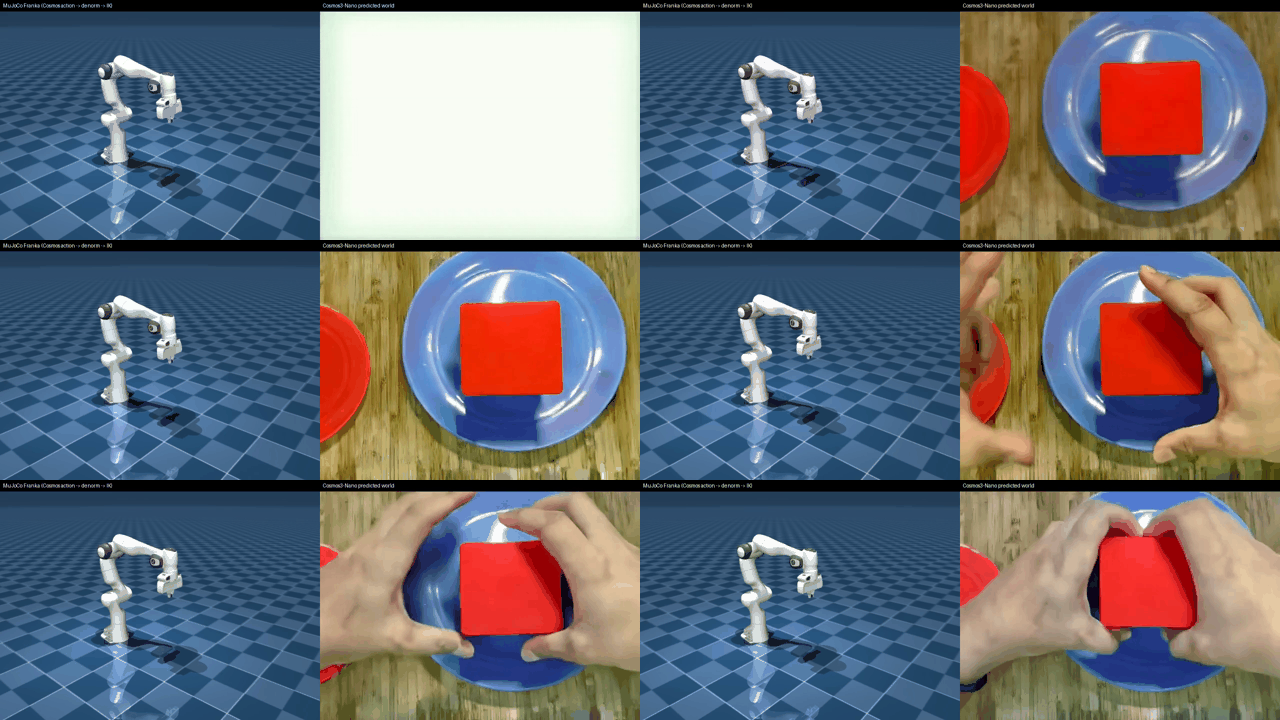
Left: MuJoCo Franka driven by a real nvidia/Cosmos3-Nano action chunk through de-normalize → decode → IK. Right: the Cosmos predicted world video from the same forward pass. Runnable: examples/vla/cosmos3_diffusers_mujoco_rollout.py --render out.mp4.
Rollout
from strands_robots import Robot

sim = Robot("panda")
sim.run_policy(
    robot_name="panda",
    instruction="pick up the red block",
    policy_provider="cosmos3",
    policy_config={"embodiment": "droid", "robot": "panda", "port": 8000},
    duration=15.0,
    control_frequency=50.0,
)
# see examples/vla/cosmos3_sim_rollout.py
robot="panda" activates the built-in DROID-layout mapping (joint_0..6/gripper → joint1..7/finger_joint1). requires_images=True.