Safety and e-stop
The manifest each robot generates, the safety chain every outside command passes, and the e-stop.
Every robot has a manifest, a safety chain and an e-stop.


from strands_robots import Robot
from strands_robots.robot.safety import RequestRefused

arm = Robot("so101")
try:
    arm.confirm_act({"elbow_flex": 3.1})
except RequestRefused as e:
    print(e)  # elbow_flex=3.1000 rad is outside its range [-1.7453, 1.5708]
Manifest
arm.manifest lists each control with its range, its safe range and what it does if the link drops. The library
builds it from the robot. Agent tools, the mesh and the dashboard all read it.
A real robot needs a range for every joint it drives. If the model leaves one without a range
(limited="false", or no range in the joint or its default class), Robot(..., port=) raises ValueError naming
the joints before it opens the port, and the range check refuses a target for such a joint. A joint that turns
without end needs a hardware.safe bound in its registry entry instead. On hardware that bound is the joint's hard
range: a target past it is refused even with the operator's yes (confirmed=True, the dashboard's confirm), and a
direct act() is clipped into it. kinova_gen3 declares one turn, ±π rad, for its continuous joints 1, 3, 5 and 7.
In a world, a joint without a range is still unconstrained.
Safety chain
Commands from agents, the dashboard or the mesh pass one chain: range, safe range, interlocks, validators, then
the operator. Your own act() calls skip the operator step. A refusal says why.
A move over time (act(..., seconds=) from an agent, the dashboard or the mesh) asks the operator once, for the
target. Every point of the move then passes the rest of the chain again. If an interlock or validator refuses a
point, the move stops there and the robot holds the last pose it reached. Interlocks are checked on each write, so
also wire a light curtain or a door switch to robot.estop() if it must stop the robot between writes.
E-stop
estop() works from any thread and nothing can block it. The robot stays stopped until a named operator resumes it.
task = arm.start(my_policy, seconds=30)
arm.estop(by="alice")             # the run stops within about 10 ms
arm.resume(approved_by="alice")
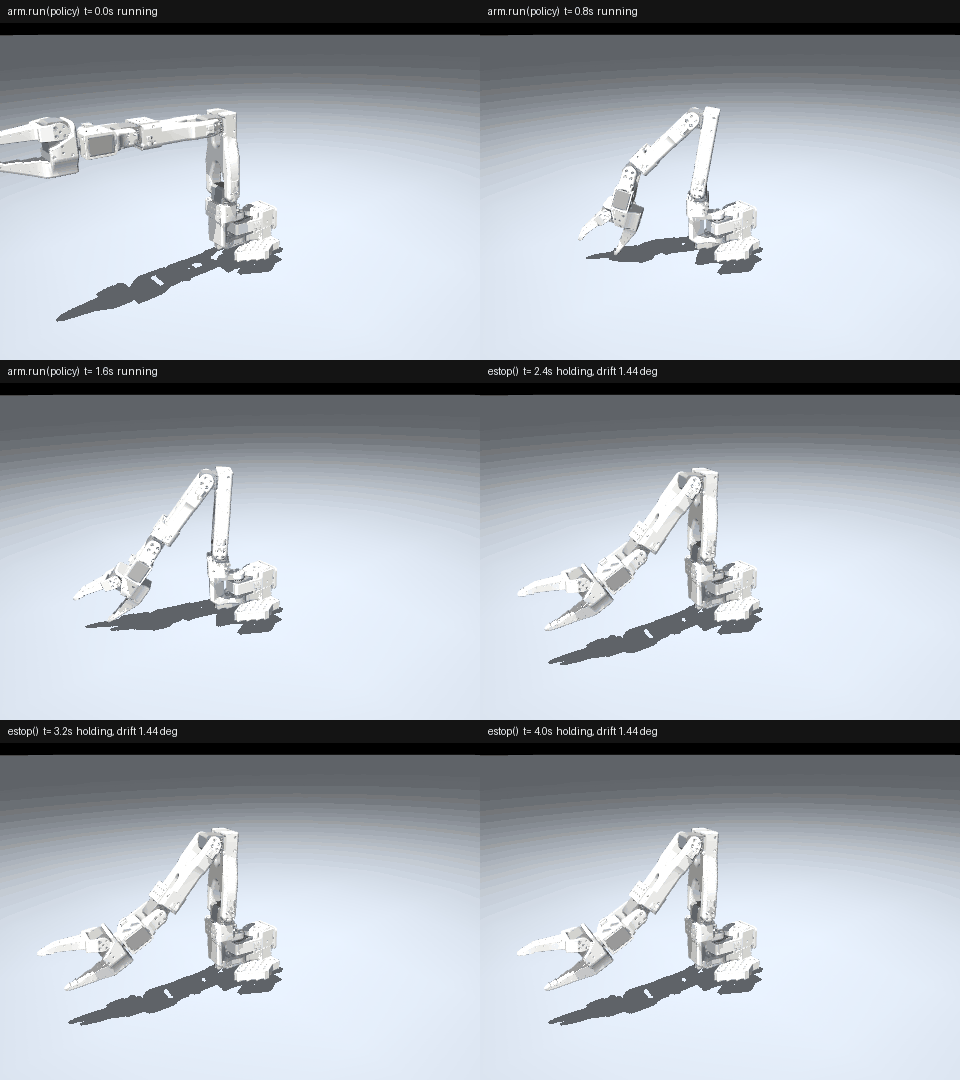
The arm holds its pose. It does not drop.
| API | Does |
|---|---|
hold() |
Stand still |
subscribe("state", fn, hz=) |
Stream the robot's state |
Watchdog |
Applies on_disconnect when commands stop |
For real robots, see the operator gate.
Edit page